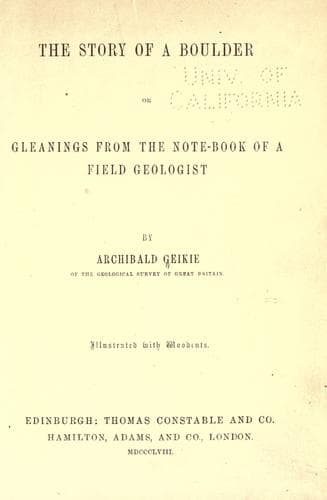
The Story of a Boulder; or, Gleanings from the Note-book of a Field GeologistGeikie, Archibald
Science
The Story of a Boulder; or, Gleanings from the Note-book of a Field Geologist
Geikie, Archibald
Geology; Petrology
First, we may notice the effect of rains in washing away the
disintegrated particles to lower levels or into river-courses whereby
fresh portions of rock become exposed to the decomposing forces. Rains
also act powerfully in altering the form of cliff-lines and steep
declivities, especially where these consist more or less of friable
earthy matter. After a long continuance of wet weather, I have seen
the abrupt sides of a river-channel that were formed of a stiff blue
clay completely cut up by rents of various dimensions, whereby large
masses had subsided many feet, while others had rolled down altogether
and lay in the bed of the stream where they were undergoing a rapid
abrasion. The cause of this alteration was obvious. The rains pouring
down from the sloping grounds on either side of the river had excavated
deep channels on the abrupt face of the cliffs, while a considerable
quantity of water finding its way through the soil, had permeated
through joints and crevices in the clay some feet from the edge of the
bank. By the combined operation of these causes, masses of clay several
yards in extent lost their cohesion and either settled down a few
feet, or found their way to the bottom. Such landslips are of frequent
occurrence where large masses of rock of a hard compact nature rest
upon loose shales and clays more or less inclined. Whole hills have
been known to be hurled in this way into the valleys below.
But these results become perhaps still more marked where to the
ordinary operations of water there are added those of intense frost.
The effects of a severe winter (such, for instance, as a Canadian one),
in loosening the particles of rocks and facilitating the breaking-up
of large masses, must be ranked among the most powerful agencies of
nature. In such a season, the percolating water with which nearly every
surface-rock is charged becomes frozen, and in the act of congelation
expands. The result of this dilatation is to exert great pressure on
the particles of the rock, and thereby loosen their cohesion. When thaw
comes the frozen liquid contracts again, but the loosened particles
have no such elastic power, and so, having lost hold of each other,
crumble down. If the season be a changeable one, frost and thaw quickly
alternating, the amount of waste produced becomes very great. Not only
is the outer surface of the stone decomposed, but the water filtering
through the joints of the rock freezes there, and thus on the arrival
of milder weather vast masses become detached from the cliffs, and
roll down, to be worn by the grinding action either of waves or of
rivers, as the case may be. Spring at last sets in with its warmth and
its showers; the snow rapidly melts away; the whole country streams
with water; every valley and hollow has its red turbid rivulet, that
bears a burden of muddy sediment into the nearest river; and thus the
loosened portions of the rocks get washed away down to sea, leaving a
Public-domain text, read in full here on John Shaqi.
Reviews
Reviews
No reviews yet
Be the first to share your thoughts on this work.
Elsewhere in the archive
Join the Discussion
Join the discussion
Sign in to leave a comment or review.
Sign InorCreate an account