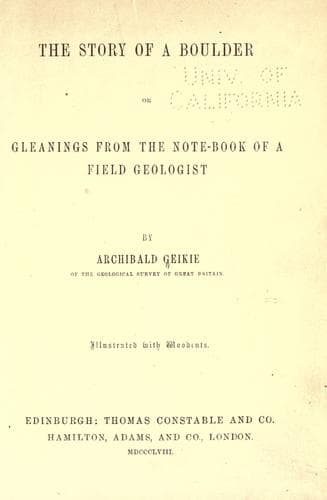
The Story of a Boulder; or, Gleanings from the Note-book of a Field GeologistGeikie, Archibald
Science
The Story of a Boulder; or, Gleanings from the Note-book of a Field Geologist
Geikie, Archibald
Geology; Petrology
From what we have seen of the wide waste and decay everywhere in
progress on the solid lands of our planet, it becomes no difficult
matter to perceive what a number of agencies must be at work in the
formation of a river channel. Let the reader take his stand in some
wooded ravine, where the shelving rocks on either side are hung all
over with verdure, and a tiny streamlet murmurs on beneath with a
flow so quiet and gentle as scarcely to shake the long pendant willow
branches that dip into its surface, while the polished pebbles that
strew its bed lie unmoved by the rippling current that glides over
them. If in the midst of such a scene the question were to arise in
his mind, How came this deep, narrow ravine into existence? what
answer would in all likelihood be the first to suggest itself? His eye
would scan the precipitous walls of the dell, with their rocks cleft
through to a depth of perchance fifty feet. It would require no great
scrutiny to assure him that the beds on the one side formed the onward
prolongations of those on the other, and that consequently there must
have been a time ere yet the ravine existed, when these beds stretched
along unbroken. Satisfied with these results, his first impulse might
be to bethink him of some primeval earthquake, when the solid land
rocked to and fro like a tempested sea, and broke up into great rents
and yawning chasms. Into one of these clefts he might suppose the
little streamlet had eventually found its way, moistening the bare and
barren rocks, until at length their surface put on a livery of moss, or
lichen, or liver-wort, and the birch, the alder, and the willow, found
a nestling-place in their crevices. Such a view of the origin of the
woody dell would be certainly a very natural one, and in some instances
might be sufficiently correct, but in the present case it will not
explain the phenomena. If the reader will kindly permit me to visit the
locality in his company, perhaps we may be able to light upon the true
explanation, and see a few appearances worthy our attention.
Public-domain text, read in full here on John Shaqi.
Reviews
Reviews
No reviews yet
Be the first to share your thoughts on this work.
Elsewhere in the archive
Join the Discussion
Join the discussion
Sign in to leave a comment or review.
Sign InorCreate an account