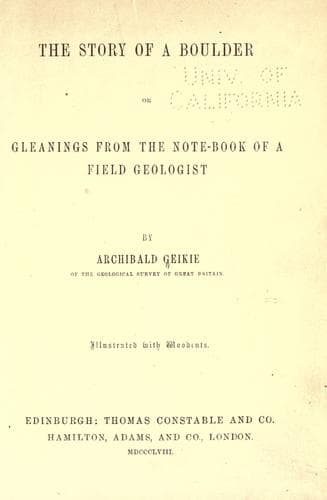
The Story of a Boulder; or, Gleanings from the Note-book of a Field GeologistGeikie, Archibald
Science
The Story of a Boulder; or, Gleanings from the Note-book of a Field Geologist
Geikie, Archibald
Geology; Petrology
in the graphic chapters of Herodotus, and the changes which the lapse
of more than twenty centuries has since wrought in its configuration.
The rivers of Europe would detain us long, not less perhaps by their
historic interest than by the variety and attractiveness of their
physical phenomena. One could scarce help lingering over the Rhine,
with its source among Alpine glaciers, its lakes and gorges, its
castles and antique towns; and when once the narrative entered the
classic ground of Italy, it would perhaps become more antiquarian than
geological. The ravine of Tivoli, for instance, would certainly lay
claim to a whole chapter for itself, with its long-continued river
action, its ancient travertin, its beautiful calcareous incrustations,
and above all its exquisite scenery.
[Footnote 53: "Fontium qui celat origines Nilus" a description not less
true now than in the days of the Sabine bard.]
"Domus Albuneæ resonantis,
Et præceps Anio, ac Tiburni lucus, et uda
Mobilibus pomaria rivis."[54]
[Footnote 54:
"Albuna's grey re-echoing home,
And Anio, headlong in his foam,
And grove of Tivoli,
And orchards with their golden gleam,
Whose boughs are dipping in the stream
That hurries to the sea."
Hor. _Carm._ L vii. 12.]
And when could we exhaust all, that might be said about the rivers of
our own land?
"Of utmost Tweed, or Ouse, or gulfy Dun,
Or Trent, who, like some Earth-born giant, spreads
His thirty arms along the indented meads
Or sullen Mole, that runneth underneath;
Or Severn swift, guilty of maidens' death;
Or rocky Avon, or of sedgy Lee;
Or coaly Tyne, or ancient hallow'd Dee;
Or Humber loud, that keeps the Scythian's name;
Or Medway smooth, or royal-towered Thame."
Passing to the new world, a vast field would spread out before us: the
Mississippi, the Atchafalaya, the Ohio, the St. Lawrence, the Amazon,
and many other rivers that in some cases rise high among the regions
of perpetual snow, and after traversing large areas of country in the
temperate zone, fall into the waters of tropical seas. By studying such
examples of river-action and delta-formation as are presented by these
gigantic streams, we should arrive at some conception of the conditions
anciently at work in producing our present coal-fields. Nor would our
researches assume aught like completion until after a scrutiny of all
the larger and more important rivers of the globe. Such a work could
be undertaken, perhaps, only by another Humboldt. Its successful
accomplishment would certainly insure the highest renown to its author,
and incalculable benefits to science.
Public-domain text, read in full here on John Shaqi.
Reviews
Reviews
No reviews yet
Be the first to share your thoughts on this work.
Elsewhere in the archive
Join the Discussion
Join the discussion
Sign in to leave a comment or review.
Sign InorCreate an account