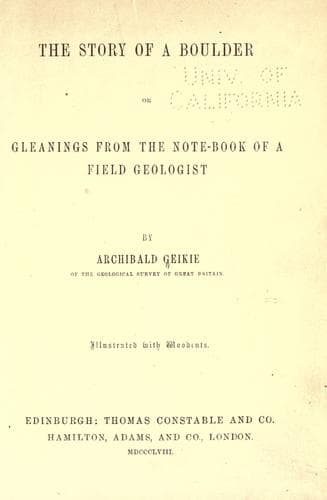
The Story of a Boulder; or, Gleanings from the Note-book of a Field GeologistGeikie, Archibald
Science
The Story of a Boulder; or, Gleanings from the Note-book of a Field Geologist
Geikie, Archibald
Geology; Petrology
But we have not yet exhausted all that the rocks at the cascade can
teach us. By dint of some exertion we climb the cliff and gain the
upper edge of the fall. The rocks that form the bed of the stream are
now seen to be deeply grooved and worn, every exposed surface having
a smoothed blunted aspect. We can mark how the stone has split up
along the natural lines of joint, whereby great facility is given to
the removing power of the current, and how large irregular angulated
blocks become detached and are swept down the stream. In not a few
parts, too, we may notice circular holes of greater or less depth, in
the bottom of each of which lie perhaps a pebble or two, that with a
constant gyratory movement, caused by the eddying water, have eaten
their way downwards into the solid rock. When the stream is in flood
and comes roaring down the rocky gorge bearing along with it a vast
amount of mud, gravel, and stones, one can easily see how the friction
of the transported material must wear down the hard bed and sides of
the channel, and how this process repeated month after month and year
after year, must aid the decomposing forces in scooping out a deep
ravine. From the cascade the ascent of the stream becomes steeper and
the run of water is consequently more rapid. Soon however we emerge
from the woody copse, and find ourselves on a flat alluvial cultivated
plain through which the rivulet winds in a tortuous meandering course,
bending back upon itself into loops that almost meet and well-nigh
form broad flat islets. Strolling along this winding route we can mark
the effects of the stream in eating away the soft clay and sand at one
part of the bend and piling them up at another. Such loose material
can present but little resistance to a stream swollen with rains, and
consequently a large quantity of the mud and gravel along with the
interspersed boulders must be swept away down into the dell at every
season of flood. The matter thus removed will of course be still
further comminuted in its passage, and at the same time will help to
grind down the hard rock surfaces over which it is driven.
Public-domain text, read in full here on John Shaqi.
Reviews
Reviews
No reviews yet
Be the first to share your thoughts on this work.
Elsewhere in the archive
Join the Discussion
Join the discussion
Sign in to leave a comment or review.
Sign InorCreate an account