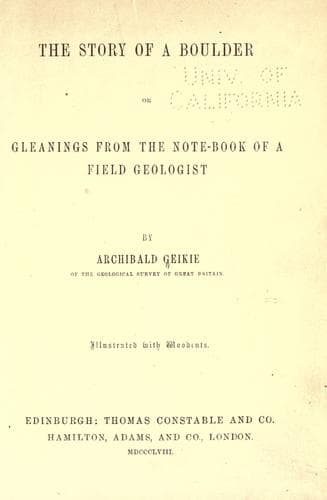
The Story of a Boulder; or, Gleanings from the Note-book of a Field GeologistGeikie, Archibald
Science
The Story of a Boulder; or, Gleanings from the Note-book of a Field Geologist
Geikie, Archibald
Geology; Petrology
Here then may be found the whole history of the ravine. Originally the
streamlet wound its devious course through a flat alluvial country with
a channel sunk but a foot or two below the level of the plain. Such
continued its character till it reached a low bluff, down which the
water flowed more rapidly to gain a second level undulating region.
The part of this bluff crossed by the stream was ere long bared of
its covering of soil and clay, and the rock below came to be washed
by a group of little cascades. Once exposed to the decomposing and
disintegrating forces, the stone soon began to decay and the cascades
ere long merged into one. By slow degrees the rock gave way and the
waterfall retreated from the bluff. For perchance thousands of years
the same process has been going on, now with greater, now with less
rapidity, according to the nature of the rocks encountered and other
modifying causes, until the fall has eaten its way back for well-nigh
three miles and scooped out a wild rocky gorge some fifty or sixty feet
deep. This is but a solitary and insignificant instance of what may be
seen all over the world, for the process remains the same whether we
stand beside a tiny rivulet in some lone Highland glen or listen to the
roar of the falls of Niagara.
There is but one other principal agency at work in the demolition of
rock-masses, the waves and currents of the ocean. But we have already
noted the effects thus produced, and need not now retrace our steps
further than to recall the vast amount of devastation which can be
shown to have been effected in our own country by marine causes, both
in breaching the existing shores and in scooping out valleys and
grinding down hills at former periods when the land was either rising
above or sinking below the level of the sea.
Having now satisfied ourselves that there goes on all over the world an
incessant waste of the solid lands, that the disintegrated debris is
washed down by rains and transported seawards by rivers, and that the
waves are ever eating their way into the iron-bound coast-line as well
as into the low alluvial shore, we naturally come to ask the result
and end of all this decay. What becomes of that vast amount of mineral
matter annually removed from the land? To be able to answer this
question clearly and distinctly, let us look for a little at what takes
place in lakes, at river-mouths, and in open sea.
Public-domain text, read in full here on John Shaqi.
Reviews
Reviews
No reviews yet
Be the first to share your thoughts on this work.
Elsewhere in the archive
Join the Discussion
Join the discussion
Sign in to leave a comment or review.
Sign InorCreate an account