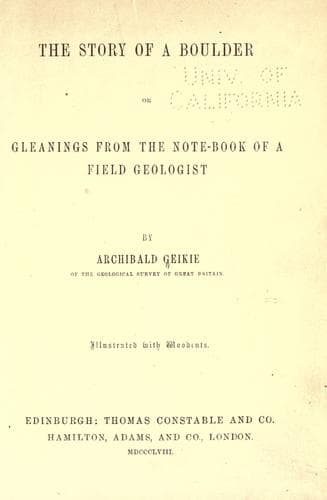
The Story of a Boulder; or, Gleanings from the Note-book of a Field GeologistGeikie, Archibald
Science
The Story of a Boulder; or, Gleanings from the Note-book of a Field Geologist
Geikie, Archibald
Geology; Petrology
while the land undergoes a continual change. Hills are insensibly
mouldering away, valleys are ever being widened and deepened, rocky
coasts and low alluvial shores suffer a constant abrasion, while
even within the bowels of the earth the process of decomposition
uninterruptedly proceeds. And thus, in place of remaining unchanged
from the beginning, we know of nothing more mutable than the land on
which we dwell, so that if the waste everywhere so apparent were to
go on unchecked or unmodified, island and continent would eventually
disappear beneath the waves. Here, however, another principle comes
into operation. The debris removed from the land, as we have seen,
is not annihilated. Slowly borne seawards, it settles down at river
mouths or on the floor of the ocean as an ever-thickening deposit,
which eventually hardens into rock, as solid and enduring as that
whence it was derived. But it does not always remain there. Owing to
the action of subterranean agencies with which we are but slightly
acquainted, different parts of the sea-bottom are continually rising.
Sometimes this process goes on very slowly, as along the shores
of Sweden, where the coast has been ascertained to emerge in some
localities at the rate of about thirty inches in a century; sometimes
with prodigious rapidity, as on the coast of Chili, where the land
was upheaved from two to seven feet in a single night. There can thus
be no doubt that the mysterious agency which produces earthquakes and
volcanoes on the land affects equally that portion of the earth's crust
covered by the waters of the ocean, and must be ceaselessly employed
in elevating large areas of sea-bottom into new continents, that will
ere long become clothed with vegetation and peopled with animals.
In contemplating, therefore, the constant decay in progress on the
surface of the land, we see not a mere isolated process of waste, but a
provision for future renovation. The sandstone cliffs of the shore are
battered down and their debris carried out to sea, but when sea-bottom
comes to be land-surface, they may be sandstone cliffs again, lashed
once more by the breakers, and once more borne as sediment to the
depths of the sea. And thus, in what may seem to us sublime antagonism,
land is ever rising in the domain of ocean, and ocean ever encroaching
on the regions of land. No sooner does a new island, or mountain peak,
or wide area of continent, appear above the waves, than the abrading
agencies are at work again. Rain, air, frost, rivers, currents,
breakers, all begin anew the process of destruction, and cease not
until the land has utterly disappeared, and its worn debris has sunk
in mid-ocean to be in process of time once more dry land, and suffer
another slow process of obliteration.
Public-domain text, read in full here on John Shaqi.
Reviews
Reviews
No reviews yet
Be the first to share your thoughts on this work.
Elsewhere in the archive
Join the Discussion
Join the discussion
Sign in to leave a comment or review.
Sign InorCreate an account