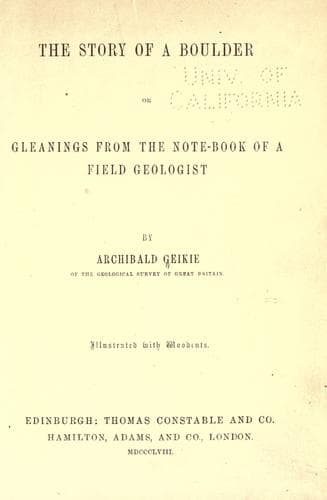
The Story of a Boulder; or, Gleanings from the Note-book of a Field GeologistGeikie, Archibald
Science
The Story of a Boulder; or, Gleanings from the Note-book of a Field Geologist
Geikie, Archibald
Geology; Petrology
Such is the economy of nature around us now, and that such will
continue to remain the condition of things in the future, we can affirm
with probability from a consideration of the history of the past. The
geologist can point to masses of rock several miles in thickness, and
occupying a large area of the globe, formed entirely of the worn debris
of pre-existing formations. The very oldest rocks with which he is
acquainted are made up of hardened sediment, pointing to the existence
of some land, even at that early period, worn down by rivers or
wasted by the sea. During all the subsequent ages the same principles
were at work, and now well-nigh the only evidence of the geological
periods is to be gathered from the layers of sediment that successively
settled down at the sea-bottom. The records which it is the task of
the geologist to decipher, are for the most part written in sand and
mud--the deposits of the ocean, for in by far the larger number of
formations into which the stratified part of the earth's crust has been
divided, and which form his only guide to the history of the past, he
can detect no trace of land. Hill and valley have alike disappeared,
and the character of their scenery and inhabitants he can often but
dimly conjecture from the nature of the sediment and of the drifted
terrestrial relics that may chance to be found among strata wholly
marine.
CHAPTER X.
The structure of the stratified part of the earth's
crust conveniently studied by the examination of a
single formation--A coal-field selected for this
purpose--Illustration of the principles necessary to such
an investigation--The antiquities of a country of value in
compiling its pre-historic annals--Geological antiquities
equally valuable and more satisfactorily arranged--Order
of superposition of stratified formations--Each formation
contains its own suite of organic remains--The age of
the boulder defined by this test from fossils--Each
formation as a rule shades into the adjacent ones--Mineral
substances chiefly composing the stratified rocks few
in number--Not of much value in themselves as a test of
age--The Mid-Lothian coal-basin--Its subdivisions--The
limestone of Burdiehouse--Its fossil remains--Its probable
origin--Carboniferous limestone series of Mid-Lothian--Its
relation to that of England--Its organic remains totally
different from those of Burdiehouse--Structure and
scenery of Roman Camp Hill--Its quarries of the mountain
limestone--Fossils of these quarries indicative of an ancient
ocean-bed--Origin of the limestones--Similar formations still
in progress--Coral-reefs and their calcareous silt--Sunset
among the old quarries of Roman Camp Hill.
Public-domain text, read in full here on John Shaqi.
Reviews
Reviews
No reviews yet
Be the first to share your thoughts on this work.
Elsewhere in the archive
Join the Discussion
Join the discussion
Sign in to leave a comment or review.
Sign InorCreate an account