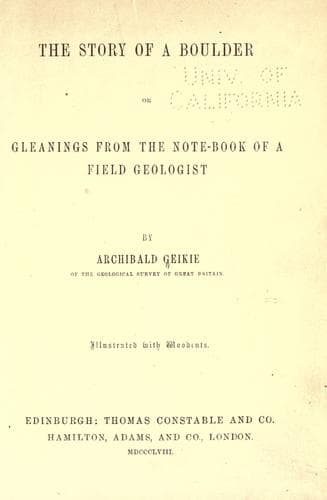
The Story of a Boulder; or, Gleanings from the Note-book of a Field GeologistGeikie, Archibald
Science
The Story of a Boulder; or, Gleanings from the Note-book of a Field Geologist
Geikie, Archibald
Geology; Petrology
Suppose the bed of the Firth of Forth were raised above the level of
the sea and covered over with verdure, and that, in ignorance of the
previous topography of the locality, a mason were to excavate on the
lately-born land the foundation for a dwelling-house. Immediately
below the grass he would com? upon layers of hardened mud containing
oyster-beds, with detached valves of cockles, mussels, fish-bones, and
perhaps the tooth of an anchor or the timber of some old herring-boat.
Now, if he were gifted with but ordinary intelligence, what would he at
once conclude from these remains? Plainly, that the spot on which he
stood had once been the bed of the sea. And if in place of appearing
as dry mud and sand these deposits had got hardened into shale and
sandstone, and the shells, too, had become hard and stony, this would
not alter his convictions. He would still assert positively that he
stood upon an old sea-bottom. And suppose further, that all this were
far away from any sea, still such a circumstance could make no change
in his opinion; he would rightly assert that the place of sea and
land might vary, and that the ocean's being now many miles distant
could be no argument against the waves having once rolled over the
site of the intended dwelling-house. Let us further imagine that he
continues his trench, and in sinking deeper comes to a bed of dark
peat with snail-shells and bones of sheep, deer, and oxen. What will
he infer from these? Clearly that they represent an old land-surface,
once covered with vegetation and browsed over by ruminant animals, and
that this old land-surface has at some distant period been submerged
beneath the sea. Suppose, moreover, that below the peat there were a
thin bed of reeds and rushes intermingled with the mouldering remains
of fresh-water shells. He would in that case infer that before the
formation of the peat the locality was occupied by a lake.
Putting now all these deductions together, our mason would have evolved
a very interesting history. He would have ascertained that in a bygone
age the spot on which he stood was the site of a lake, tenanted by
delicate shells and fringed with reeds and rushes, where the coot and
the mallard may have reared their young; that in process of time the
vegetation gained upon the water, choking up the lake, so as gradually
to form a soil firm enough to support sheep, deer, and oxen, and
yielding shady coverts whither the antlered stag could retire and lay
him down to die; that in after years the sea had encroached upon the
peat-moss, and oyster-beds begun to form where cattle had been wont to
browse; that again the ocean receded, and the land emerged to assume
new verdure and receive new inhabitants.
Public-domain text, read in full here on John Shaqi.
Reviews
Reviews
No reviews yet
Be the first to share your thoughts on this work.
Elsewhere in the archive
Join the Discussion
Join the discussion
Sign in to leave a comment or review.
Sign InorCreate an account