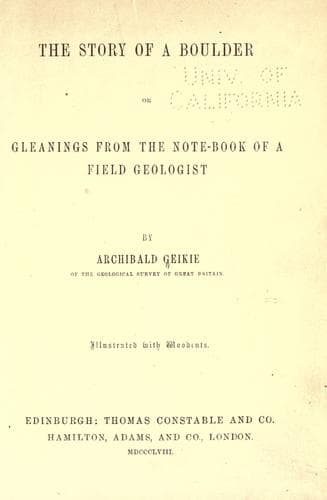
The Story of a Boulder; or, Gleanings from the Note-book of a Field GeologistGeikie, Archibald
Science
The Story of a Boulder; or, Gleanings from the Note-book of a Field Geologist
Geikie, Archibald
Geology; Petrology
Now, in all this reasoning there is no hypothesis or speculation. The
mason proves himself an intelligent, honest fellow, and uses his eyes
and his head where many other men would perchance see very little need
for the use of either. There can be no setting aside of his story;
he can appeal to facts. "There," says he, "is a layer of peat with
the rush-stalks and moss-fibres matted together in the soft brown
mouldering substance, exactly as I have seen them a hundred times in
the peat-cuttings on the moors, and I cannot but believe that they
must both have had the same origin, that is, that they grew in swampy
hollows of the land. There, too, lies a stratum of fresh-water shells
identical with those that occur in our ponds and marshes. Although
mouldering now, they are evidently not fragmentary, but entire and
unbroken; some of them are young, others full-grown, and they lie
grouped together as in our present lakes. Such shells could only live
in fresh water, therefore the spot where I stand must have been at one
time a fresh-water lake. There, again," he continues, "is a bed of
oysters which cannot have been transported hither, for their valves are
together, lying just as they do in our present oyster-beds. This green
field, therefore, must have been at one period a muddy sea-bottom."
After this manner and upon this kind of evidence must all inquiries
into the past changes of the earth's surface be conducted. And provided
only we proceed cautiously, reasoning from positive facts, and
striving as far as possible to exhaust what Bacon calls the "negative
instances," our deductions possess all the certainty of truth. For in
much the same fashion do we derive no small part of our acquaintance
with the early history of our own land, as well as with the arts
and customs of other nations. The scattered relics turned up by the
operations of the farmer--wooden canoes, flint hatchets, gold torques,
bronze pots, fragments of pottery, and rusty coins--all have their
bearing upon the annals of the country, and so clear is the evidence
which they read out that an eminent antiquary has divided the early
ages of Scotland into three periods, distinguished, from the character
of their relics, as the "Stone Period," the "Bronze Period," and the
"Iron Period."[57] But in such a classification the historian has
little to guide him save the nature of the relics themselves. He places
the rudest first, and groups the rest in succession, according to the
degree of advancement in civilisation which they respectively indicate.
And the grouping seems just, though in some cases objects belonging
to two of these periods may have been to some extent contemporaneous,
just as thatched roofs gave way to tiles, tiles to slates, and slates
partly to lead, though at the present day a walk of half an hour in
some localities will bring before us specimens of all these styles
still in use. If, however, the relics of geological history lay
Public-domain text, read in full here on John Shaqi.
Reviews
Reviews
No reviews yet
Be the first to share your thoughts on this work.
Elsewhere in the archive
Join the Discussion
Join the discussion
Sign in to leave a comment or review.
Sign InorCreate an account