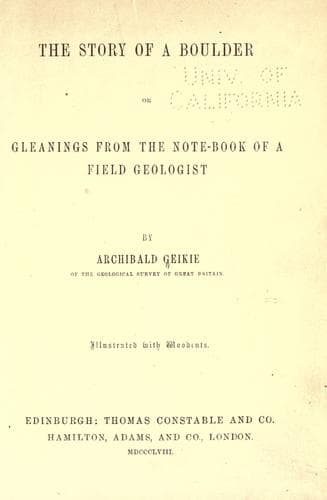
The Story of a Boulder; or, Gleanings from the Note-book of a Field GeologistGeikie, Archibald
Science
The Story of a Boulder; or, Gleanings from the Note-book of a Field Geologist
Geikie, Archibald
Geology; Petrology
In higher latitudes, where the lower limit of the snow-line descends to
the level of the sea, the glaciers are often seen protruding from the
shore, still laden with blocks that have been carried down from valleys
far in the interior. The action of storms and tides is sufficient to
detach large masses of the ice, which then floats off, and is often
wafted for hundreds of miles into temperate regions, where it gradually
melts away. Such floating islands are known as icebergs.
II. In climates such as that of Canada, where the winters are very
severe, the rivers become solidly frozen over, and, if the frost be
intense enough, a cake of ice forms at the bottom. In this way sand,
mud, and rocky fragments strewing the banks or the channel of the
stream, are firmly enclosed. When spring sets in, and the upper parts
of the rivers begin to thaw, the swollen waters burst their wintry
integuments, and the ice is then said to _pack_. Layer is pushed
over layer, and mass heaped upon mass, until great floes are formed.
These have often the most fantastic shapes, and are borne down by the
current, dropping, as they go, the mud and boulders, with which they
are charged, until they are stranded along some coast line, or melt
away in mid-ocean.
III. But icebergs are also produced by the freezing of the water of
the ocean. In high latitudes, this takes place when the temperature
falls to 28·5° of Fahrenheit. The surface of the sea then parts with its
saline ingredients, and takes the form of a sheet of ice, which, by
the addition of successive layers, augmented sometimes by snow-drifts,
often reaches a height of from thirty to forty feet. On the approach of
summer these ice-fields break up, crashing into fragments with a noise
like the thundering of cannon. The disparted portions are then carried
towards the equator by currents, and may be encountered by hundreds
floating in open sea. Their first form is flat, but, as they travel on,
they assume every variety of shape and size.
On the shores of brackish seas, such as the Baltic, or along a coast
where the salt water is freshened by streams or snow-drifts from the
land, sheets of ice also frequently form during severe frosts. Sand and
boulders are thus frozen in, especially where a layer of ice has formed
upon the sea-bottom.[3] The action of gales or of tides is sufficient
to break up these masses, which are then either driven ashore and
frozen in a fresh cake of ice, or blown away to sea. The bergs formed
in this way have originally a low flat outline, and many extend as
ice-fields over an area of many miles, while, at a later time, they may
be seen towering precipitously as great hills, some 200 or 300 feet
high.
Public-domain text, read in full here on John Shaqi.
Reviews
Reviews
No reviews yet
Be the first to share your thoughts on this work.
Join the Discussion
Join the discussion
Sign in to leave a comment or review.
Sign InorCreate an account