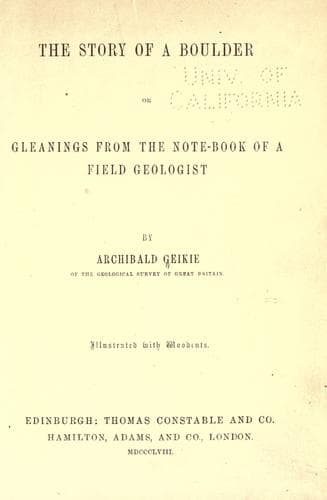
The Story of a Boulder; or, Gleanings from the Note-book of a Field GeologistGeikie, Archibald
Science
The Story of a Boulder; or, Gleanings from the Note-book of a Field Geologist
Geikie, Archibald
Geology; Petrology
The fossils of Roman Camp Hill are not drifted specimens. They must
have lived and died where the quarryman now finds them. We recognise
them as all unequivocally marine; corals, crinoids, and brachiopodous
molluscs, are all clearly the denizens of the sea, and hence we
conclude that they mark the site of an ancient ocean. The snail-shells
that swarm about the fruit-trees of our orchards not more unmistakably
indicate a land-surface than do these petrified relics evidence an old
sea-bottom. We can argue, too, from the crowded way in which they lie
grouped together, that life must have been prolific in these primeval
waters. Every fragment of the rock shows its dozens, nay, hundreds,
of stone-lily joints, disjointed indeed, yet easily recognisable.
They must have swarmed as thickly along the floor of the sea as the
strong-stemmed tangle that darkens the bottom of many a picturesque
bay along our western coasts, yet with a gracefulness of outline such
as none of our larger sea-weeds can boast. Less numerous but not less
markedly _in situ_ are the shells of productus and spirifer, the former
with its finely-striated surface fresh as if the creature had died but
yesterday, while the slender spines with which it was armed lie strewed
around. In short, the whole suite of organisms points to a period of
tranquil deposition in a sea of probably no great depth, where the
lower forms of the animal kingdom flourished in abundance, contributing
by their calcareous secretions to form continuous layers of limestone.
Public-domain text, read in full here on John Shaqi.
Reviews
Reviews
No reviews yet
Be the first to share your thoughts on this work.
Elsewhere in the archive
Join the Discussion
Join the discussion
Sign in to leave a comment or review.
Sign InorCreate an account