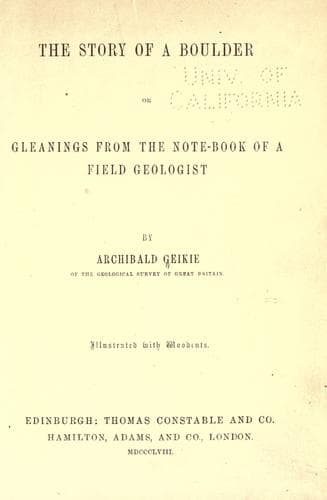
The Story of a Boulder; or, Gleanings from the Note-book of a Field GeologistGeikie, Archibald
Science
The Story of a Boulder; or, Gleanings from the Note-book of a Field Geologist
Geikie, Archibald
Geology; Petrology
Such a condition of things finds a parallel in many parts of the globe
at the present day. Thus, the shores of the islands of the Pacific
are white with fine calcareous mud, that results from the action
of breakers on the surrounding coral-reefs. This mud, enveloping
fragments of coral, shells, sea-weed, drift-wood, and other extraneous
substances, hardens on exposure, and becomes eventually a limestone,
travertine, or calc-sinter. We may believe that the same process goes
on out at sea, around the edges of atolls or circular coral-reefs,
and that the sediment thus thrown down will enclose any zoophytes
or molluscan remains that may lie at the sea-bottom, along perhaps
with _fuci_, and occasional water-logged fragments of wood that have
been drifted from land. Along the shores of Guadaloupe a bed of this
calcareous silt has formed since America was colonized by man, for it
has been found to contain fragments of pottery, arrow-heads, and other
articles of human workmanship.[62] The same rock has yielded, besides,
the partially-petrified bones of several human skeletons, one of which,
though without the head, forms a prominent object among the fossil
treasures of the British Museum. The rock in which these remains are
embedded is described as harder than statuary marble, notwithstanding
its recent origin. By supposing the same process to be carried on over
a large area and for a long period, we may see how a continuous stratum
of limestone could be elaborated, full of fossil relics of corals,
molluscs, and other marine productions. And in some such way, we may
be permitted to believe, the seams of limestone on Roman Camp Hill
were accumulated. The billows of that old carboniferous ocean may not
have sent up their white surf against the margin of snowy coral-reefs,
but the currents below did their work of demolition as effectually,
and by sweeping through the submarine groves of stone-lilies and
cup-corals, as the night winds of autumn sweep athwart the heavy-laden
fields, would prostrate many a full-grown stem and scatter its
loosened joints among the thickening lime that covered the bottom.
Stone-lily, cup-coral, net-coral, productus, spirifer, pinna, nautilus,
orthoceratite, all would eventually be entombed amid the decaying
remains of their congeners, and thus produce a slowly-increasing seam
of limestone.
[Footnote 62: Lyell's _Manual of Elementary Geology_, p. 121. Fifth
edition.]
Public-domain text, read in full here on John Shaqi.
Reviews
Reviews
No reviews yet
Be the first to share your thoughts on this work.
Elsewhere in the archive
Join the Discussion
Join the discussion
Sign in to leave a comment or review.
Sign InorCreate an account