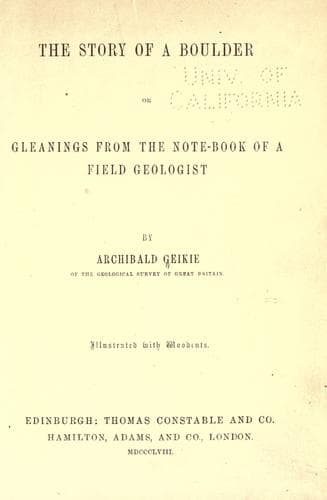
The Story of a Boulder; or, Gleanings from the Note-book of a Field GeologistGeikie, Archibald
Science
The Story of a Boulder; or, Gleanings from the Note-book of a Field Geologist
Geikie, Archibald
Geology; Petrology
For years the subject of the origin of coal formed one of the many
battle-fields on which geologists delighted to break lances. They
ranged themselves under two banners, the "drift"-theory men and the
"growth"-theory men, the former maintaining strenuously that coal
was simply vegetation transported from the land and deposited in
large troughs at river-mouths or sea-bottoms, the latter as eagerly
contending that the vegetation had not been drifted, but grew on
the very locality where its remains are now exhumed. Neither party
lacked plausible arguments in support of its doctrines. The "drift"
combatants stoutly affirmed it to be contrary to all experience that
a land-surface should be so oscillating as their opponents required,
that in short it was absurd to hold each coal-seam as marking a period
of elevation, for there were often dozens of seams in as many yards
of strata, some of them scarcely an inch thick, and yet, according to
the "growth" theory, each would have required for its accumulation
a special uplifting of the land above the sea-level. These and many
other difficulties were thought to be triumphantly overcome by the
hypothesis of transport and deposition. The vegetation borne down
by some ancient Mississippi would collect in vast rafts, and these
becoming water-logged would sink to the bottom, where, by getting
eventually covered over with silt and sand, they would in process of
time be chemically altered into coal. This explanation was, however,
vigorously resisted by the opposite side. They alleged that the "drift"
theory could account neither for the wide extent of coal-seams nor
for their remarkable persistency in thickness. If the vegetation had
really been hurried out to sea by river-action, it seemed natural to
expect that the coal-seams should occur in sporadic patches of very
unequal thicknesses, according as the drifted plants had been more
densely or more loosely packed. But this was found not to be the case
in point of fact. The coal-seams were ascertained to be generally
singularly continuous, and to retain for the most part a pretty uniform
thickness over considerable areas. And what was still more worthy of
note, they were, as a whole, markedly free from extraneous matter,
such as sand and mud. Where these impurities did occur, it was usually
in the form of intercalated seams or partings, often quite as regular
and extensive as the coal itself. Had the vegetation, therefore, been
transported into the sea, it could hardly fail to get mixed up with
the fine impalpable mud which, like that of the Ganges or Mississippi,
might have discoloured the ocean for leagues from the river-mouth,
and settled down as a thickening stratum at the sea-bottom. And many
other arguments, derived from the nature and arrangement of the strata
interbedded among the coal-seams, were urged to prove that the latter
had originated from vegetation which grew on the spot.
Public-domain text, read in full here on John Shaqi.
Reviews
Reviews
No reviews yet
Be the first to share your thoughts on this work.
Elsewhere in the archive
Join the Discussion
Join the discussion
Sign in to leave a comment or review.
Sign InorCreate an account