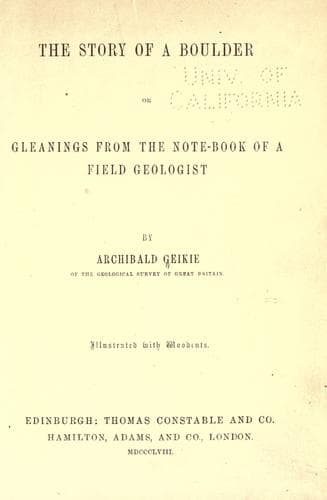
The Story of a Boulder; or, Gleanings from the Note-book of a Field GeologistGeikie, Archibald
Science
The Story of a Boulder; or, Gleanings from the Note-book of a Field Geologist
Geikie, Archibald
Geology; Petrology
Calcareous shale.
Limestone (marine), eight feet.
Calcareous shale, with _spirifers_, &c.
Coal, six to eight inches.
Fire-clay.
Sandstone.
A short way further down the stream another bed of limestone occurs
with several seams of coal below it, one of them attaining a thickness
of six feet.
In addition to the thin seam at Esperston, the Mid-Lothian field
contains several others. Of these by much the most important is that
known as the North Greens Seam. It varies in thickness from only a
few inches to fully 5 feet, and has been extensively worked for the
_parrot_ or gas-coal which it contains. It rests upon a pavement of
shale, sometimes of fire-clay, and occurs about midway between two
thick marine limestones, being from 80 to 90 feet distant from each.
I have laid open many a block of the parrot-coal at the pit mouth,
and marked the well-defined outlines of the stigmaria covered with a
yellowish efflorescence of iron pyrites, like gilded figures upon
a black velvet ground. The plants lie with their divergent rootlets
spread out regularly along the stem like teeth on the back of a comb,
thus seeming to indicate no hurried agglomeration by some tidal wave or
turbid river, but rather a slow and tranquil deposition.
The fossils of the coal-seams consist for the most part of the
plants above described, which we saw to belong to _terrestrial
species_. But the reader will now understand that in dealing with
organic remains we cannot infer, because a certain stratum contains
nothing but land-plants, that it must necessarily by consequence be a
land-formation. For we have seen that the plants of the Burdiehouse
limestone, though all terrestrial, gave no support to the idea that the
rock had originated on land. In all such cases regard must be had not
only to the nature of the imbedded organisms, but their condition and
mode of occurrence, and to the character of those associated with them.
Especial care must be taken to distinguish what has been transported
from what is _in situ_, otherwise, by attending only to one part of
the evidence, we shall miss the import of the whole, and altogether
misinterpret the records which we seek to decipher.
Public-domain text, read in full here on John Shaqi.
Reviews
Reviews
No reviews yet
Be the first to share your thoughts on this work.
Elsewhere in the archive
Join the Discussion
Join the discussion
Sign in to leave a comment or review.
Sign InorCreate an account