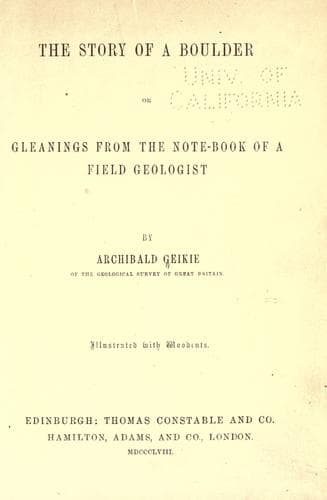
The Story of a Boulder; or, Gleanings from the Note-book of a Field GeologistGeikie, Archibald
Science
The Story of a Boulder; or, Gleanings from the Note-book of a Field Geologist
Geikie, Archibald
Geology; Petrology
[Footnote 64: If it be correct to set down the North Greens coal-seam
as really representing a terrestrial surface, that is, of course, a
flat delta or plain scarcely raised above the sea-level, we must, I
suspect, call in the aid of a slight elevatory process, or else hold
that the depth of the sea at the locality where the lower limestone was
forming did not exceed 80 or 90 feet, and may have been considerably
less, and that this space came to be eventually filled up by the
detritus of the river. But the wide extent and sometimes the great
thickness of the limestone beds seem to indicate a greater depth, and
thus favour the idea of an elevation of the sea-bottom to form the
North Greens coal-seam.]
Now this condition of things differs entirely from what is presented
by the Mountain Limestone group of England. That formation, when
typically developed, attains a thickness of from 1000 to 2000 feet, and
gives rise to that green hilly kind of scenery whence it has derived
its name. It is unequivocally a marine deposit, since it abounds in
corals, echinoderms, brachiopodous molluscs, and other productions of
the deep. Northward, however, it undergoes a gradual change, getting
greatly thinner, and split up by a series of intercalations of shale
and sandstone. This alteration goes on until, on the border-land
between the two countries, the massive limestone of Derbyshire has
dwindled down into a series of thin beds, often widely separated by
intervening strata, which contain many seams of coal. After crossing
the Silurian district, and descending the northern slopes of the
Lammermuir Hills, we get into the Carboniferous system again, and find
its limestone series still farther diminished. With this decrease
of marine formations, we can detect an augmentation of coal-bearing
strata. Thus the Berwickshire coal-field lies in this lower set of
beds, far under the coal-measures of Newcastle. In the Lothians, too,
as has been shown, coal is extensively worked in the same series, and
these seams also find their representatives in Fife and Lanarkshire.
The gradual change from the kind of strata found on the horizon of
the Burdiehouse limestone, to those occurring on the horizon of the
Mountain limestone, indicates, as we saw, a gradual change of the
conditions of deposition; and the nature of this alteration is shown by
the difference in the character of the imbedded fossils. The passage
of the massive Derbyshire limestone into the thin limestones and
coal-bearing sandstones of the north, as decidedly marks another change
in the relative position of sea and land. The former was a succession
in time, the latter was one in space, but the mode of reasoning remains
the same for both. In the former case, we saw estuarine strata passing
upward into others wholly marine, and the order of superposition told
us that the locality was first an estuary, and then slowly became open
sea. In the latter case, we see marine beds not succeeded by estuarine
Public-domain text, read in full here on John Shaqi.
Reviews
Reviews
No reviews yet
Be the first to share your thoughts on this work.
Elsewhere in the archive
Join the Discussion
Join the discussion
Sign in to leave a comment or review.
Sign InorCreate an account