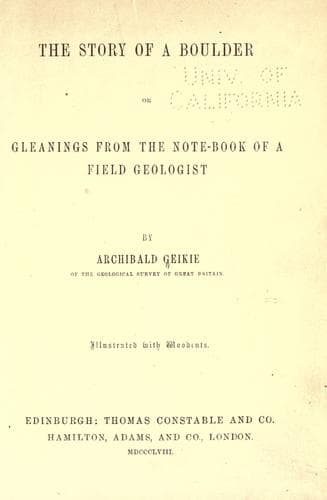
The Story of a Boulder; or, Gleanings from the Note-book of a Field GeologistGeikie, Archibald
Science
The Story of a Boulder; or, Gleanings from the Note-book of a Field Geologist
Geikie, Archibald
Geology; Petrology
strata, but becoming estuarine strata themselves. The thick limestones
gradually thin out horizontally into a great series of sandstones and
shales, with interbedded coal-seams, so that what bears evidence of a
deep sea at the one end, gives proof of a muddy and sandy delta at the
other. In other words, during the ages represented by what we call the
Mountain Limestone, the central and south-western portions of England
lay far below a wide breadth of ocean, and nourished a luxuriant crop
of stone-lilies, mingled with the other denizens of the deep, while the
Border district, and the whole of central Scotland, exhibited all the
conditions of a vast delta, sometimes spreading out as broad verdant
jungles, anon showing only scattered irregular groups of low, bare
mud-banks and sand-spits, which at other times disappeared altogether
beneath the dun discoloured waves. Now the reader will not fail to
mark that this curious and interesting fact in the past history of our
country, is ascertained solely from a comparison of fossil remains.
The stone-lilies and shells of Derbyshire, and the lepidodendra and
land-plants of the Lothians, form our sole basis of evidence, and we
may rest on them with as perfect certainty as if they were so many duly
attested documents deposited among the archives of our State-Paper
Office.
In our survey of the coal-field of Mid-Lothian, we have passed from
the Lower Carboniferous estuary beds of Burdiehouse to the Middle
Carboniferous marine beds of Roman Camp Hill, and their associated
terrestrial strata,--the coal-seams and fire-clays. We come now, in our
upward progress, to the Upper Carboniferous group, or Coal-measures
proper.[65] These strata rest immediately upon the limestones, and
attain a depth here of over three thousand feet. They consist of a
great series of sandstones, shales, coals, and fire-clays, that vary
in thickness from less than an inch to many feet, or even yards. The
coal-seams are especially variable, many of them existing as mere films
of carbonaceous matter; others varying up to a depth of fourteen feet.
There are from fifty to sixty that exceed a foot, but the average
thickness throughout the whole series is about three and a half
feet.[66] They are nearly all underlaid by fire-clay or shale, and very
generally have a roof of the latter material.
[Footnote 65: These terms--Lower, Middle, and Upper Carboniferous, are
used for want of others, and for the sake of clearness. They must not
be regarded, however, as equivalent to similar groupings of the English
carboniferous rocks, for the Scottish series is probably much older
than the greater part of the English, and coeval, to a considerable
extent, with the mountain limestone and millstone grit of the latter
country.]
[Footnote 66: See Milne on Mid-Lothian Coal-field. _Trans. Royal Soc.
Edin._ vol. xiv. p. 256, whence the above details are taken.]
Public-domain text, read in full here on John Shaqi.
Reviews
Reviews
No reviews yet
Be the first to share your thoughts on this work.
Elsewhere in the archive
Join the Discussion
Join the discussion
Sign in to leave a comment or review.
Sign InorCreate an account