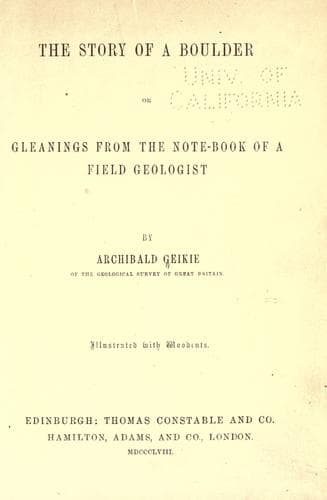
The Story of a Boulder; or, Gleanings from the Note-book of a Field GeologistGeikie, Archibald
Science
The Story of a Boulder; or, Gleanings from the Note-book of a Field Geologist
Geikie, Archibald
Geology; Petrology
If my reader will now suppose this sand of the Indian river to be
hardened into sandstone, the mud in like manner compressed into
shale, and the peat beds chemically altered into coal, can he fail to
perceive the striking analogy between the section thus displayed and
those already given from the Mid-Lothian and Cape Breton coal-fields?
The differences between the ancient and modern strata are not in kind
but in degree. The Scottish series reaches to more than six times the
thickness of the Indian one, and the coal-seams in the one exceed in
individual thickness the peat-beds in the other. We must remember,
however, that the climate of Hindustan is not remarkably favourable to
the accumulation of vegetable matter, the heat being so great that the
plants decay almost as rapidly as they grow. And it should likewise
be borne in mind, that were the conditions of subsidence and of the
gradual accumulation of sedimentary matter to continue even in the same
ratio as heretofore, the Ganges might, in the course of ages, heap up
a series of stratified sands, clays, and peat-beds, many thousand feet
in thickness, and many thousand square miles in extent, rivalling,
or perhaps surpassing in depth, the largest coal-field in the world.
The parallelism between this delta and an ordinary coal-field holds
singularly close, not merely as regards the nature of the stratified
deposits. The alluvial plain of Bengal has undergone a process of
subsidence to an unknown depth, whereby successive areas of terrestrial
vegetation have been carried down to be entombed beneath fluviatile
sand and mud. It is likewise subject to the more sudden operation
of earthquakes, whereby large tracts of country become permanently
altered, and changes are effected on the direction, rapidity, and
detritus of the streams. It is, moreover, liable to wide-spread
inroads of the sea, which sometimes covers cultivated districts to
a depth of several feet, laying waste the fields and destroying the
inhabitants. These and other features help us to understand the origin
of such vast masses of sedimentary strata as those of our coal-fields,
where terrestrial, fluviatile, and marine remains alternate in rapid
sequence, or sometimes occur together.
Public-domain text, read in full here on John Shaqi.
Reviews
Reviews
No reviews yet
Be the first to share your thoughts on this work.
Elsewhere in the archive
Join the Discussion
Join the discussion
Sign in to leave a comment or review.
Sign InorCreate an account