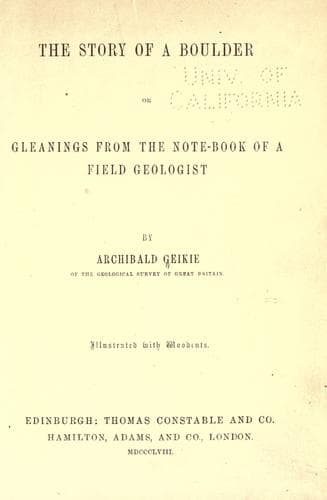
The Story of a Boulder; or, Gleanings from the Note-book of a Field GeologistGeikie, Archibald
Science
The Story of a Boulder; or, Gleanings from the Note-book of a Field Geologist
Geikie, Archibald
Geology; Petrology
The origin of the constant succession of coal seams, sandstones, and
shales, of the Edge series may be thus accounted for. The area of
Mid-Lothian formed part of a great delta, which, like that of the
Ganges, was undergoing a gradual subsidence during the Carboniferous
era. The rate of this movement probably varied at different times, and
might even be occasionally interrupted by short periods of elevation.
When the ever-increasing accumulations of silt brought down by the
river reached or nearly reached the surface of the water, they would
become the site of wide tracts of swampy vegetation that flourished
for hundreds or thousands of years. Eventually, however, these
jungles, invaded by the changing currents of the river, were buried
beneath a thick deposit of fluviatile sediment, or more probably the
vegetation might become unable to keep pace with an accelerated rate
of submergence, and the forests would then be tranquilly carried
down beneath the water, and soon covered over with sand and mud. The
detrital matter might in like manner continue to be deposited over the
sunk forest for many years, perhaps centuries, until the muddy bottom
again reached the surface, and once more waved green with sigillariæ,
calamites, and lepidodendra. Another long interval might here elapse,
in which a thick bed of vegetable matter might accumulate, much after
the manner of the formation of peat among the bogs and mosses of our
own country. The periodical inundations of the river probably gave
rise to wide marshes and lagoons, often tenanted by lacustrine shells,
and thickly overgrown with aquatic vegetation. The decaying plants
decomposed the red ochreous matter with which the water was charged,
and re-deposited it among the mud and rotting leaves at the bottom as
a carbonate of iron. Such ferruginous accumulations, often entombing
fern-stems and other plants, with scales and teeth of ganoidal fishes,
sometimes _conulariæ_ and _lingulæ_, and, in certain localities, whole
acres and miles of fresh-water shells, are known now as our _clay-band_
and _black-band ironstones_. We can easily conceive that, in shallower
parts of the lagoons, a dense growth of marshy plants might spring
up, preventing any deposition of iron, and when the whole came to be
covered over with later accumulations of sand or mud, the deeper parts
of the old lake would be covered with a seam of ironstone, and the
shallower portions would display a bed of coal. In some such way we
may account for the frequent passage of ironstone into coal, and coal
into ironstone in many of our coal-fields. If undisturbed by the ever
changing currents of the river, these wide expanses of marsh and lake
might continue for many long years, the constant evaporation being
counterbalanced by continual supplies of water from the main stream.
Eventually, however, owing perhaps to another period of more rapid
submergence, the water gained the ascendency, and once more rolled over
Public-domain text, read in full here on John Shaqi.
Reviews
Reviews
No reviews yet
Be the first to share your thoughts on this work.
Elsewhere in the archive
Join the Discussion
Join the discussion
Sign in to leave a comment or review.
Sign InorCreate an account