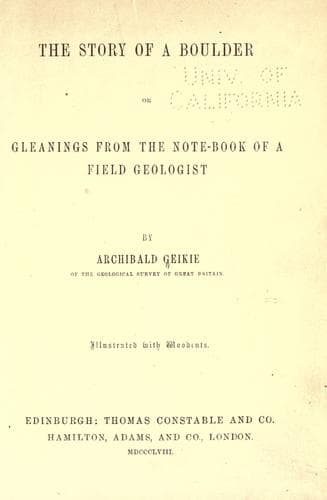
The Story of a Boulder; or, Gleanings from the Note-book of a Field Geologist — John Shaqi
The Story of a Boulder; or, Gleanings from the Note-book of a Field GeologistGeikie, Archibald
Science
The Story of a Boulder; or, Gleanings from the Note-book of a Field Geologist
Geikie, Archibald
Geology; Petrology
[Footnote 4: The account of the origin of these giants, as given in
the prose _Edda_, is very graphic, and may be not inaptly quoted
here:--"When the rivers that are called Elivagar had flowed far from
their sources," replied Har, "the venom which they rolled along;
hardened, as does dross that runs from a furnace, and became ice.
When the rivers flowed no longer, and the ice stood still, the vapour
arising from the venom gathered over it and froze to rime; and in this
manner were formed in Ginnungagap many layers of congealed vapour,
piled one over the other."--"That part of Ginnungagap," added Jafnhar,
"that lies towards the north, was thus filled with heavy masses of
gelid vapour and ice, whilst everywhere within were whirlwinds and
fleeting mists. But the southern part of Ginnungagap was lighted by
the sparks and flakes that flew into it from Muspellheim.... When the
heated blast met the gelid vapour, it melted into drops, and, by the
might of him who sent the heat, these drops quickened into life, and
took a human semblance. The being thus formed was named Ymir, from whom
descend the race of the Frost-giants (Hrim-thursar), as it is said in
the Völuspá, 'From Vidolph came all witches; from Vilmeith all wizards;
from Svarthöfdi all poison-seekers; and all giants from Ymir.'"--See
Mallet's _Northern Antiquities_, edit. Bohn, p. 402.]
[Footnote 5: That beautiful expression of Æschylus occurs to me, so
impossible adequately to clothe in English: ἁνηριθμον γελασμα κυματων.
Who that has spent a calm summer day upon the sea, has not realized its
force and delicate beauty?]
The iceberg melts away, but not without leaving well-marked traces of
its existence. If it disappear in mid-ocean, the mud and boulders, with
which it was charged, are scattered athwart the sea-bottom. Blocks
of stone may thus be carried across profound abysses, and deposited
hundreds of miles from the parent hill; and it should be noticed, that
this is the only way, so far as we know, in which such a thing could
be effected. Great currents could sweep masses of rock down into deep
gulfs, but could not sweep them up again, far less repeat this process
for hundreds of miles. Such blocks could only be transported by being
lifted up at the one place and set down at the other; and the only
agent we know of, capable of carrying such a freight, is the iceberg.
In this way, the bed of the sea in northern latitudes must be covered
with a thick stratum of mud and sand, plentifully interspersed with
boulders of all sizes, and its valleys must gradually be filled up as
year by year the deposit goes on.
Public-domain text, read in full here on John Shaqi.
Reviews
Reviews
No reviews yet
Be the first to share your thoughts on this work.
Join the Discussion
Join the discussion
Sign in to leave a comment or review.
Sign InorCreate an account