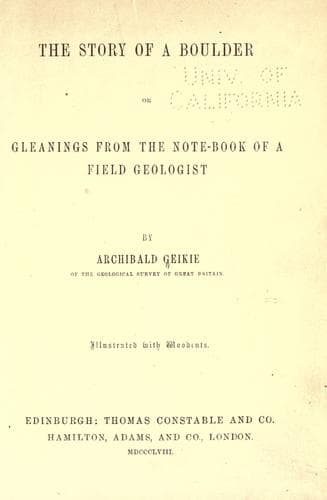
The Story of a Boulder; or, Gleanings from the Note-book of a Field GeologistGeikie, Archibald
Science
The Story of a Boulder; or, Gleanings from the Note-book of a Field Geologist
Geikie, Archibald
Geology; Petrology
[Footnote 73: Of course, this deduction is founded, as the reader
will notice, on the assumption that we have now the series, as it was
deposited, and that no peaty swamp or forest was denuded away, and its
site occupied by sand and silt. But the assumption is rendered probable
from the conditions of formation indicated by the Roslyn group.]
In some of the streamlets that flow into the beautifully wooded vale
of the Esk, south of Penicuik, these limestones can be well seen,
worn in the water-channel, or crusted over with moss along the banks.
Their organisms are singularly abundant, and consist of cyathophylla,
encrinites, spirifers, producti, &c., all exclusively marine. In a
picturesque brook that falls into the Esk near a saw-mill in the
grounds of Penicuik House, I have seen the little cup-corals clustered
by dozens on the weathered rock, showing their delicate striated
wrinkles in high relief among the scattered valves of productus and
innumerable joints of the stone-lily. They were all well preserved, and
in their grouping and general appearance differed in no respect from
similar organisms in the mountain limestone of Roman Camp Hill. The
inference to be drawn from them must accordingly correspond with what
has been deduced from the mountain limestone fossils, viz., that they
mark the site of a sea-bottom which remained free from mud and sand for
considerable periods, during each of which there abounded corals and
shells, whose exuviæ went to form several seams of limestone. But that
this sea-bottom was at no period very far distant from land, is proved
by the drifted plants that occur in the sandstones and shales both
below and above, and which often show so little trace of maceration,
that we can hardly believe they were carried far, or floated for a long
while previous to being enveloped in the sand or mud at the bottom. I
have never detected vegetable remains in the limestones themselves, but
there seems no reason why they should not be found there.
Public-domain text, read in full here on John Shaqi.
Reviews
Reviews
No reviews yet
Be the first to share your thoughts on this work.
Elsewhere in the archive
Join the Discussion
Join the discussion
Sign in to leave a comment or review.
Sign InorCreate an account