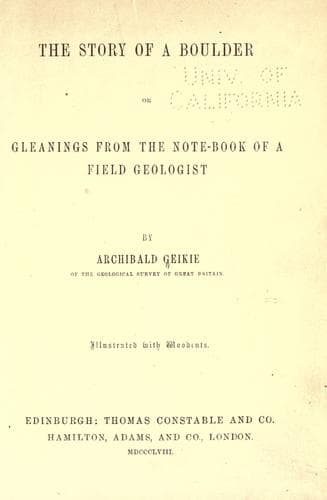
The Story of a Boulder; or, Gleanings from the Note-book of a Field GeologistGeikie, Archibald
Science
The Story of a Boulder; or, Gleanings from the Note-book of a Field Geologist
Geikie, Archibald
Geology; Petrology
One of the most remarkable and difficult phenomena presented by these
limestones is their great persistency. I have traced them over a
large part of Mid-Lothian, from the highly inclined beds at Joppa to
the contorted and faulted strata near Carlops. I have found them,
too, in many parts of West-Lothian and Stirlingshire, from the sea at
Borrowstounness southwards into Lanarkshire. They likewise occur in
Fife, and seem to sweep away through Lanark and Ayrshire. The area
in which I have found them cannot be much under 700 square miles,
yet they are probably spread over a much greater extent of country.
Throughout this region they appear to continue on the whole at pretty
much the same vertical distance from each other, and average three or
four feet thick each. They vary in number, three being found in parts
of Mid-Lothian, in other parts only two. Throughout West-Lothian there
seem to be but two seams in the middle or moor-rock series, and the
same two seams are found passing over into Perth near Culross. There
are differences, too, in the structure and composition of the seams,
one running sometimes as a single bed of dull blue limestone, and
then gradually splitting up into three layers of a greyer and more
earthy texture, with soft shale between them. But making all these
abatements, the observer cannot fail to be struck with the general
regularity and continuity of these limestones. And the fact becomes
all the more remarkable when we consider the great irregularity, and
continual intercalations, and repetitions of the strata, both above and
below. Marine beds are usually persistent over large areas, especially
where extensively developed. As they decrease in thickness, their
continuity for the most part lessens, so that the rule is, on the
whole, a safe one, the thinner any particular stratum, the less likely
are we to trace it to a considerable distance. Yet, not only are these
Mid-Lothian limestones thin, but they occur in regular sequence among
a set of continually alternating and very irregular beds, and extend
over several hundred square miles of country. And this, too, not in a
single seam, but in two, three, or even more, so that the difficulty of
accounting for such intercalations is proportionately increased.
Public-domain text, read in full here on John Shaqi.
Reviews
Reviews
No reviews yet
Be the first to share your thoughts on this work.
Elsewhere in the archive
Join the Discussion
Join the discussion
Sign in to leave a comment or review.
Sign InorCreate an account