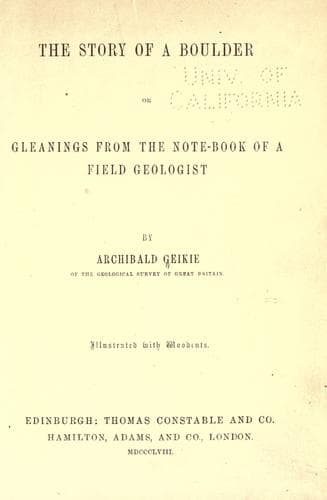
The Story of a Boulder; or, Gleanings from the Note-book of a Field GeologistGeikie, Archibald
Science
The Story of a Boulder; or, Gleanings from the Note-book of a Field Geologist
Geikie, Archibald
Geology; Petrology
kinds, and large predatory fish, swarmed in these old waters, and their
calcareous shells and skeletons are now broken up by the quarryman and
the collier as hard compact limestone.
After these animals had lived and died in successive generations,
perhaps for thousands of years, the downward movement of the earth's
crust seems to have ceased for a while or to have become greatly less.
The effect of this would be just to reverse what had been previously
done, especially if a slight elevatory movement took place. The streams
would in such circumstances descend from the uplifted ground with
renewed velocity and transport their detritus to gradually increasing
distances. The muddy and sandy sediment thus borne seawards would
slowly silt over the coral-banks at the bottom, and in conditions so
ungenial the organisms would dwindle down and finally die out. A great
thickness of sand and mud would be spread out over their remains so
long as the currents from the land continued to carry sediment out to
sea, and thus probably originated the sandstones and shales superposed
above the lowest limestone.
Eventually the old steady downward movement returned, and with it the
corals and stone-lilies. The detritus again sank to the bottom much
nearer the land, forming great banks and shoals that choked up the
river-mouth. Seaward the water regained its purity, and the bottom
once more swarmed with living things. Another lapse of many thousand
years may have here intervened during which the marine exuviæ gathered
into another seam of limestone, until again the process of subsidence
either ceased for a time, or what is perhaps more probable, became
considerably feebler. Detrital matter began to creep seaward as
before, and eventually entombed the corallines and crinoids to a great
depth. The calcareous bed thus formed is the second limestone, and the
superincumbent silt-beds represent the sandstones and shales that rest
above it.
Public-domain text, read in full here on John Shaqi.
Reviews
Reviews
No reviews yet
Be the first to share your thoughts on this work.
Elsewhere in the archive
Join the Discussion
Join the discussion
Sign in to leave a comment or review.
Sign InorCreate an account