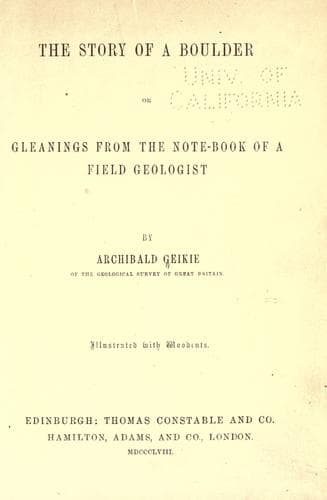
The Story of a Boulder; or, Gleanings from the Note-book of a Field GeologistGeikie, Archibald
Science
The Story of a Boulder; or, Gleanings from the Note-book of a Field Geologist
Geikie, Archibald
Geology; Petrology
In some such way as this does the Roslyn sandstone series appear to
have originated. I have indicated what seems to have been the main
features in the process, but it was probably a very complex one. There
may have been a great many oscillations of level of variable effects,
some of them raising the disturbed area to a much greater height at
one point than at another. This inequality would of course produce
marked effects along a low flat country such as that at the mouth of a
great river. New currents would be produced and the direction of old
ones changed; great shoals and banks of silt would be worn down only
to be thrown up again at some new point, where another oscillatory
movement would expose them afresh to destructive denudation. The
variations in the amount of elevation and depression would likewise
modify the transport of detritus to the sea, and give rise to a varied
and ever-changing sea-bottom. In short, the alternations and variations
must have been endless, for to the ordinary multiplied interchanges of
a delta we must add those induced by a constant and unequal oscillation
of the earth's crust.
The Roslyn sandstone series comes to a close, and passing onward in
ascending scale we meet with another great group of coal-bearing
strata. They occupy the central area of the Mid-Lothian coal-field,
and from their gentle inclination as compared with the lower strata
that rise up from under them on either side of the basin, are known as
the _Flat Coals_. Their total thickness--that is to say, all that has
escaped denudation--amounts to a thousand feet or more. They consist
chiefly of sandstones, shales, ironstones, and fire-clays, with from
twenty to twenty-five seams of coal, of which sixteen are thick enough
to be worked. Their similarity to the Edge coals below points to a
similarity in the conditions of formation. The frequent alternations
of sandstone and shale show how the delta gradually pushed outwards
again and re-occupied its ancient site above the successive forests of
the Edge series and the successive coral-beds of the Roslyn group. The
coal-seams indicate the further progress of the detrital accumulations,
and the eventual formation of vast swampy flats that nourished a rank
growth of stigmariæ, and tracts of drier ground waving with ferns, and
shadowed by the spiky foliage of the club-moss and the broader fronds
of the tree-fern.
Public-domain text, read in full here on John Shaqi.
Reviews
Reviews
No reviews yet
Be the first to share your thoughts on this work.
Elsewhere in the archive
Join the Discussion
Join the discussion
Sign in to leave a comment or review.
Sign InorCreate an account