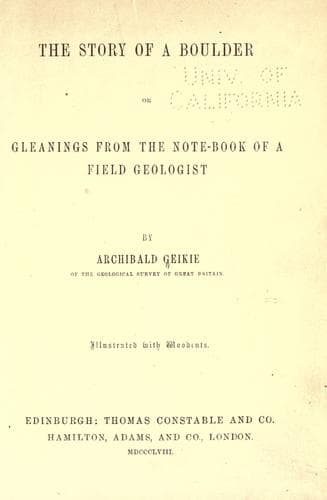
The Story of a Boulder; or, Gleanings from the Note-book of a Field GeologistGeikie, Archibald
Science
The Story of a Boulder; or, Gleanings from the Note-book of a Field Geologist
Geikie, Archibald
Geology; Petrology
But one other form needs to be mentioned here as characteristic of the
Carboniferous intrusive trap-rocks--that of great amorphous masses
which cut through the strata irregularly. They have not the wall-like
form of dykes, nor do they conform to the line of bedding of the rocks
among which they occur. They are sometimes irregular lumps, lying
above or among the strata, and probably connected with some vein or
dyke below. In other localities they look like the upper ends of vast
pillars which may descend into the very depths of Tartarus, as though a
great hole had been blown through the crust of the earth, and a column
of melted matter had risen to fill the cavity. Such masses are often
called _bosses_, and seem not unfrequently to have been the craters
of eruption whence great sheets of lava and showers of ashes were
ejected far and wide over the neighbourhood. They serve to connect
the intrusive traps, whose age is always more or less uncertain, with
the bedded traps properly so called, the geological date of which can
usually be sufficiently ascertained.
II. The bedded or contemporaneous trap-rocks consist of two well-marked
kinds. There are, 1st, the melted rocks, such as greenstones and
basalts and 2d, the tufas and volcanic ashes.
Those of the first-named class differ in no respect from the traps
already noticed, so far as regards mineralogical texture, general
structure, and appearance. In hand specimens the intrusive and bedded
greenstones and basalts cannot be distinguished, nor even when examined
in the field and in masses extending over considerable areas is it
always possible to say to which division any particular hill or crag
should be assigned. The reason of this resemblance is obvious. Where a
trap has either cut through or insinuated itself among rocks of earlier
date it is called intrusive, in relation to the rocks so traversed,
and of course we cannot be sure to what geological period it should be
referred, nor how long an interval may have elapsed between the time
when these rocks were forming and the time when the trap was intruded
among them. If, however, the igneous rock passed upward through these
same strata and then spread out as a flat sheet along the sea-bottom,
the part that came to the top would be termed contemporaneous
with the deposits going on at the time. Hence it follows that all
contemporaneous lava-form trap-rocks are at the same time intrusive as
regards the strata passed through in their progress to the surface. If
the sheet of melted matter that spread out below the water were in the
course of ages worn completely away, along with the strata subsequently
piled above it, so as to leave merely a neck or dyke filling up the
cavity through which the lava rose, we should pronounce the remnant
intrusive, and could form no certain conclusion as to its age or
as to whether its site had ever been a crater actively at work in
throwing out lava and ashes. The sole difference, therefore, between a
Public-domain text, read in full here on John Shaqi.
Reviews
Reviews
No reviews yet
Be the first to share your thoughts on this work.
Elsewhere in the archive
Join the Discussion
Join the discussion
Sign in to leave a comment or review.
Sign InorCreate an account