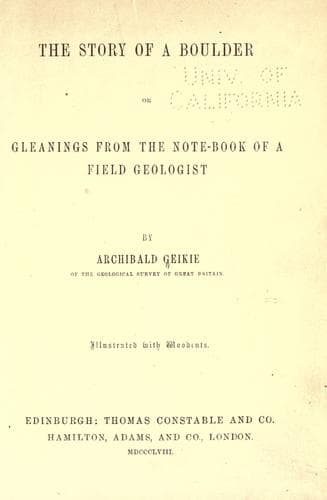
The Story of a Boulder; or, Gleanings from the Note-book of a Field GeologistGeikie, Archibald
Science
The Story of a Boulder; or, Gleanings from the Note-book of a Field Geologist
Geikie, Archibald
Geology; Petrology
contemporaneous and an intrusive greenstone is simply this: the former
rose through a fissure until it reached the surface, and then rolled
out as a flat parallel sheet; the latter may have been erupted from
below at the same time, yet, owing to different circumstances, never
reached the surface, but spread out among or cut through the strata
underneath. And so, when we come to examine in quarries, ravines, and
other exposures, the remains of two such eruptions, we soon ascertain
the relative age of the former from that of the strata among which it
occurs, but as to the date of the latter we are wholly at a loss, for
it gives us no clue by which we can show whether it was erupted before
or after the other. We can but compare the mineralogical character
of the intruded with that of the contemporaneous masses in the same
district, and, from the resemblance which may be traced between them,
draw at the best but a doubtful inference as to their relative dates.
The contemporaneous traps always assume a bedded form, the intrusive
occasionally do so; and the question naturally arises here, what are
the tests whereby a bed of trap may be known to be contemporaneous and
not intrusive? The answer is happily a simple one. An intrusive mass
is found to alter to a greater or less extent the rocks in contact
with it; if it occur as a dyke, then the beds on either side have
been cut through and probably otherwise affected; if it take the form
of a bed or sheet, the strata lying above and below it will be found
to be both altered, showing evidently that a heated mass has been
interposed between them, and consequently that the igneous rock is of
later date than any of the strata among which it occurs. In the case
of a contemporaneous melted trap, however, the appearances presented
are different; it always takes the form of a flat bed corresponding
to all the inclinations and curvatures of the sandstones, shales,
limestones, or other strata among which it lies. If examined carefully,
it may be found not unfrequently baking and contorting the bed that
forms its pavement, but producing no change whatever on that which
composes its roof. It may be capped and underlaid by layers of shale,
and in such a case we might not improbably find the shale below it
highly baked, so as to resemble a sort of rude pottery, while the shale
above would present no sign of such metamorphism, but on the contrary
might display its delicate plants or shells down to the very surface
of the trap, and were the latter concealed from view we should never
suspect, from the aspect of this shale, that any igneous rock existed
in the neighbourhood. The inference to be drawn from such appearances
seems very obvious. Had the upper shale been in existence when the
greenstone or basalt was erupted, it would have suffered an alteration
similar to that produced on the shale below; and the fact, plain and
palpable, that it has undergone no such change, shows pretty clearly
Public-domain text, read in full here on John Shaqi.
Reviews
Reviews
No reviews yet
Be the first to share your thoughts on this work.
Elsewhere in the archive
Join the Discussion
Join the discussion
Sign in to leave a comment or review.
Sign InorCreate an account