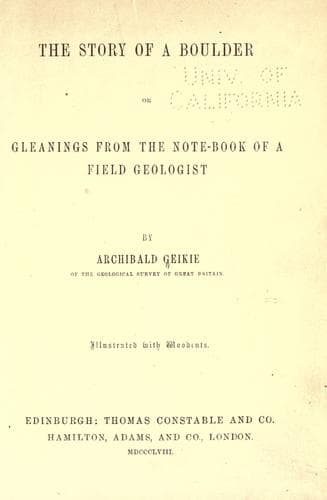
The Story of a Boulder; or, Gleanings from the Note-book of a Field GeologistGeikie, Archibald
Science
The Story of a Boulder; or, Gleanings from the Note-book of a Field Geologist
Geikie, Archibald
Geology; Petrology
The Hebrides are but the shattered relics of an old land that had its
mountain-peaks and its glens, its streams and lakes, and may have
nursed in its solitude the red-deer and the eagle, but was never
trodden by the foot of man. A glance at the map is enough to convince
us of this. We there see islands, and peninsulas, and promontories,
and deep bays, and long-retiring inlets, as though the country had
been submerged and only its higher points remained above water. The
conviction is impressed more strongly upon us by a visit to these
shores. We sail through the windings of one of the "sounds," and can
scarcely believe that we are on the bosom of the salt sea. Hills rise
on all sides, and the water, smooth as a polished mirror, shows so
pure and limpid that in the sunshine we can see the white pebbles that
strew its bed many fathoms down. The eastern shore is often abruptly
interrupted by long-receding lochs edged round with lofty mountains,
and thus, where we had looked to see a deep heathy glen, with,
perchance, a white tree-shaded mansion in the far distance, and a few
dun smoking cottages in front, we are surprised to catch a glimpse of
the white sails of a yacht, or the darker canvas of the herring-boats.
We sail on, and soon a sudden turn brings us abruptly to the mouth of
the sound. A bold headland, studded around with rocky islets, rises
perpendicularly from the sea, bleak and bare, without a bush or tree,
or the faintest trace of the proximity of man. The broad swell of the
Atlantic comes rolling in among these rocks, and breaks in foam against
the grey cliffs overhead. In tempests, such a scene must be of the most
terrific kind. Wo to the hapless vessel that is sucked into the vortex
of these breakers, whose roar is sometimes heard at the distance of
miles! Even in the calmest weather the white surf comes surging in,
and a low sullen boom is ever reverberating along the shore. We see
the harder rocks protruding far into the sea, and often pierced with
long twilight caves, while the softer ones are worn into deep clefts,
or hollowed out into open bays strewed over with shingle. The sunken
rocks and islets, scarcely showing their tops above water, were all
evidently at one time connected, for, as we recede from the shore, we
can mark how the process of demolition goes on. There is first the
projecting ness or promontory, well-nigh severed from the mainland, but
still connected by a rude arch, through which the swell ever gurgles
to and fro. Then, a little farther from the shore, a huge isolated
crag, washed on all sides by the surge, raises its grey lichen-clothed
summit. A short way beyond, there is the well-worn islet whose surface
shelters neither lichen nor sea-weed, but is ever wet with the dash of
the waves. Further to the sea, the white gleam of the breakers marks
the site of the sunken rock. Thus, in the space of a hundred yards, we
may sometimes behold the progress of change from land to sea, and see
Public-domain text, read in full here on John Shaqi.
Reviews
Reviews
No reviews yet
Be the first to share your thoughts on this work.
Join the Discussion
Join the discussion
Sign in to leave a comment or review.
Sign InorCreate an account