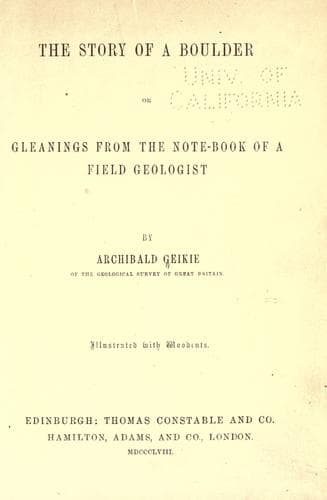
The Story of a Boulder; or, Gleanings from the Note-book of a Field GeologistGeikie, Archibald
Science
The Story of a Boulder; or, Gleanings from the Note-book of a Field Geologist
Geikie, Archibald
Geology; Petrology
we arrive at the important conclusion that the strata in which the
remains of cyprides abound must have been deposited in lakes or rivers.
This gives us a key by which to interpret some of the changes of a
geological system, and the ancient physical revolutions of large tracts
of country.
The shales of the coal-measures sometimes contain the cypris cases in
such abundance as to derive therefrom a sort of fissile structure.
It should be borne in mind, however, that each animal may during its
lifetime have possessed in succession several of these cases. Among the
shell-bearing molluscous animals, the little shell which contains the
creature in its youngest stages remains ever after as an integral part
of the outer calcareous case. As the inhabitant grows, it continues
to add band after band to the outer edge of the shell, each of which,
whilst preserving the general symmetry and proportions of the whole
structure, increases its dimensions in every way. Among the univalves,
such, for example, as the turritella, so common on our shores, the
layers of growth succeed each other like the steps of one of those
long spiral stairs that our feudal forefathers loved to build from
the court-yard to the watch-tower of their castles. Each new layer
exceeding in bulk its predecessors, adds a new step to the ascending
pile, and thus the ever-widening mouth winds spirally upwards around
the central pillar. The bivalves exemplify the same principle. The
successive additions are made in a crescent form to the outer edges,
and form those prominent concentric ridges so conspicuous on many of
our commoner shells, such, for instance, as some of those in the genera
_Astarte_ and _Venus_.
But the architecture of the Crustacea (and, of course, that of the
cyprides) is conducted on a very different principle. Their houses
admit of no additions or enlargements, and so, when the animals find
themselves getting somewhat straitened, they retire to a sheltered
spot, and there, separating the walls that hem them in, crawl out like
soft lumps of dough. The outer membrane of the moulted animal quickly
acquires strength and hardness, and in a day or two the renovated
creature is as healthy and vigorous as ever. In this process it is
not merely an external shell, like that of a mollusc, which is thrown
off, but a veritable skin, so that when the old shell is abandoned
it frequently could not be detected on a first glance to be empty,
the outer crust of every leg and joint, and sometimes even of thin
bristles, remaining just as in the living animal.
Public-domain text, read in full here on John Shaqi.
Reviews
Reviews
No reviews yet
Be the first to share your thoughts on this work.
Elsewhere in the archive
Join the Discussion
Join the discussion
Sign in to leave a comment or review.
Sign InorCreate an account