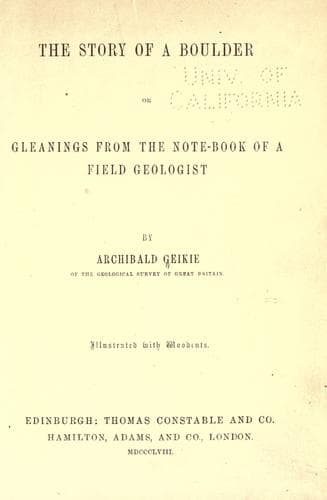
The Story of a Boulder; or, Gleanings from the Note-book of a Field GeologistGeikie, Archibald
Science
The Story of a Boulder; or, Gleanings from the Note-book of a Field Geologist
Geikie, Archibald
Geology; Petrology
It is not unlikely that this process of moulting takes place annually
in most of the Crustacea, so that if we suppose a fossil member of the
group to have lived six years, it would have left six crusts to be
entombed in any deposits that might be forming at the time. Of course
there would be many chances against all the six being preserved, but
the possibility of at least several of them becoming fossilized should
be borne in mind when we speculate on the abundance of such organisms
in any geological formation.
I might refer to another very interesting group of crustacean animals
known as the _Limuli_, or king-crabs, of which there were at least
three representatives during the times of the English Carboniferous
system (Fig. 20-3). They are remarkable chiefly for their large
crescent-shaped shield, their long sword-like tail, and their double
pair of eyes, of which the outer ones are large, sessile, and compound,
like those of the trilobites, while the middle pair are small, simple,
and set close together on the forehead, like those of the single-eyed
Cyclops in the old mythology. Altogether, with their shields, swords,
watchful waking eyes, strong massive armour, and great size (for some
of them measure two feet in length), they form a most warlike genus.
CHAPTER VI.
Carboniferous fauna continued--George Herbert's ode on
"Man"--His idea of creation--What nature teaches on
this subject--Molluscous animals--Range of species in
time proportionate to their distribution in space--Two
principles of renovation and decay exhibited alike in the
physical world and the world of life--Their effects--The
mollusca--Abundantly represented in the carboniferous
rocks--Pteropods--Brachiopods--Productus--Its alliance with
Spirifer--Spirifer--Terebratula--Lamellibranchs--Gastropods--
Land-snail of Nova Scotia--Cephalopods--Structure of orthoceras--
Habits of living nautilus.
Holy George Herbert, in one of the most remarkable odes of the
seventeenth century, sang quaintly, yet nobly, of the dignity of man.
He looked into the design and nature of the human heart, and saw there
a palace that had been built for the abode of the Eternal. Deserted
though it might be, broken down and in ruins, yet there still lingered
a trace of its ancient glory, and the whole material world still
testified to its inherent greatness. He looked abroad on the face of
nature, and saw, in all its objects and all its movements, a continued
ministration to man.
"For us the windes do blow;
The earth doth rest, heav'n move, and fountains flow.
Nothing we see, but means our good,
As our delight, or as our treasure;
The whole is, either our cupboard of food,
Or cabinet of pleasure.
Public-domain text, read in full here on John Shaqi.
Reviews
Reviews
No reviews yet
Be the first to share your thoughts on this work.
Elsewhere in the archive
Join the Discussion
Join the discussion
Sign in to leave a comment or review.
Sign InorCreate an account