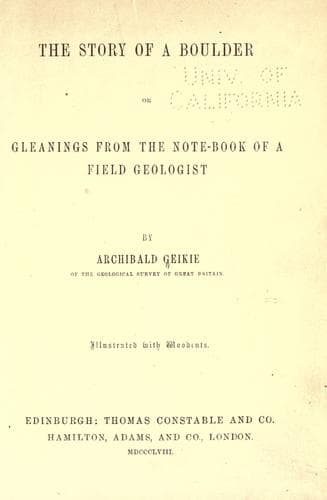
The Story of a Boulder; or, Gleanings from the Note-book of a Field GeologistGeikie, Archibald
Science
The Story of a Boulder; or, Gleanings from the Note-book of a Field Geologist
Geikie, Archibald
Geology; Petrology
Now, a genus widely diffused, and capable of enduring great differences
in the temperature and other conditions of the ocean, would probably
suffer least from any great physical changes. If all the sea at one
locality were converted into land, the genus would be driven into other
districts, and thrive as abundantly as ever; or, even supposing that it
should become locally extinct, it would still be abundantly represented
in other oceans of the globe. In the course of many ages, after many
such slow revolutions in the configuration of land and sea, the genus
might perhaps become greatly reduced in numbers, until at length some
final elevation of the sea-bed, or other change, might cause its total
extinction. In the _rhynconella_, we perhaps see one of these genera in
its last stage. Any great change in northern latitudes would probably
destroy the arctic species, and a similar change around New Zealand
might gradually extinguish the southern one.
Looking, then, from this point of view into the past history of life
upon our planet, we see that such extinctions have often taken place.
At first, many of these widely-diffused genera were created. They
were represented by a large number of species as well as individuals,
and ranged over all the oceans of the globe; but in tracing out their
history, we mark one species after another passing away. Some of them
lived for but a comparatively short period; others came in with the
beginning and saw out the end of an entire geological system; but of
all these early species there is not now a single one extant, though
some of the genera still inhabit our seas. It is plain, therefore,
that but for the operation of another principle, all the genera, too,
would ere this have become extinct, for the whole can contain no more
than the sum of its parts; and if these parts are destroyed the whole
must perish simultaneously. As the species of certain genera died out,
however, their places were from time to time filled up with new ones,
yet the rate of increase became ever less and less than the rate of
decrease, so that the numbers of such genera grew fewer with every
successive period, and have reached their minimum in existing seas.
There are instances, however, in which this ratio was reversed, the
list of added species continually outnumbering that of the extinct,
till the genus reached its maximum, when it either continued at that
stage till the present day, or began slowly to decline.
Public-domain text, read in full here on John Shaqi.
Reviews
Reviews
No reviews yet
Be the first to share your thoughts on this work.
Elsewhere in the archive
Join the Discussion
Join the discussion
Sign in to leave a comment or review.
Sign InorCreate an account