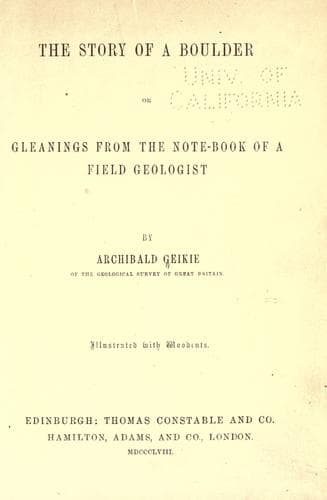
The Story of a Boulder; or, Gleanings from the Note-book of a Field GeologistGeikie, Archibald
Science
The Story of a Boulder; or, Gleanings from the Note-book of a Field Geologist
Geikie, Archibald
Geology; Petrology
There is another point suggested by the occurrence of mollusca in the
Carboniferous system, to which it may be well to refer, namely, the
curious, and as yet not wholly understood fact, that the range of
animals in time is in some way proportionate to their range in space.
In other words, it often happens (so often, indeed, as apparently to
indicate a law) that the more widely diffused a genus is found to be
at the present day, the farther back can we trace its remains into the
geological ages. This fact probably depends upon causes, many of which
are still unknown to us; but the following remarks may help the reader
to a notion of the general bearings of the subject.[34]
[Footnote 34: The law is more especially exemplified by the mollusca,
but it may eventually be found to characterize other classes. We,
perhaps, see traces of it in the present distribution of the two most
ancient orders of icthyic life--the placoids and ganoids.]
In the profounder recesses of the ocean, the temperature remains more
or less uniform all over the globe.[35] In these undisturbed regions
there occur, along with corals and other humble animals, many kinds of
mollusca, such as terebratulæ, craniæ, scissurellæ, &c. These are very
generally found not to be confined to one province or limited district,
but to flourish in every sea from Hudson's Bay to Hindustan. One of
the causes of this wide distribution is the uniformity of temperature
that characterizes the depths in which they live. They can migrate
from one ocean to another, from the torrid zone to the polar circle,
without experiencing any destructive change in the thermal conditions
of their element. And provided only they meet with no barrier in the
form of a lofty submarine mountain chain or profound abyss, and can
secure the requisite food in their journey, we know no reason why some
of these shells may not thus extend themselves over wide areas. Of the
two species of _rhynconella_ now living, one inhabits the depths of
the icy sea, the other enjoys the warmer waters that lave New Zealand.
The species, in this case, seem (for the fact cannot yet be accepted
as fully proved) to occupy a more limited area, while the genus has a
larger range.
[Footnote 35: The stratum of constant temperature runs in a wave-like
form from pole to pole. In the arctic and antarctic oceans it is found
at a depth of 4500 feet, whence it slopes upwards so as to reach the
surf ice at the temperate zone on both sides of the equator. It then
gradually sinks down in the warmer regions, till at the equator it is
7200 feet below the sea-level. There are thus one tropical and two
polar basins separated by two wave-like circles, or, as a geologist
would say, three synclinal troughs separated by two anticlinal ridges.]
Public-domain text, read in full here on John Shaqi.
Reviews
Reviews
No reviews yet
Be the first to share your thoughts on this work.
Elsewhere in the archive
Join the Discussion
Join the discussion
Sign in to leave a comment or review.
Sign InorCreate an account