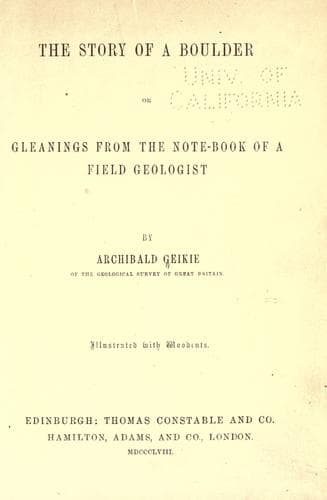
The Story of a Boulder; or, Gleanings from the Note-book of a Field GeologistGeikie, Archibald
Science
The Story of a Boulder; or, Gleanings from the Note-book of a Field Geologist
Geikie, Archibald
Geology; Petrology
The organic remains hitherto described belong to that large division
of the animal kingdom instituted by Lamarck, to comprehend all those
whose internal structure is supported by no vertebral column, and
which are hence termed invertebrate. They are for the most part
protected by a hard outer covering, or exo-skeleton, which assumes
many different modifications. We have seen it in the calcareous
cells of the little net-like fenestella, in the geometric cup of
the stone-lily, in the double case of the cypris, and in the shells
of the mollusca. But the order of nature does not always exactly
correspond with the classification of the naturalist. His system
must necessarily be precise, formal, and defined. One tribe ends off
abruptly, and is immediately succeeded by another, with different
functions and structure, and dignified with a separate name. But in
the order of creation, such abrupt demarcations are few, for if they
exist in the present economy, they can not unfrequently be filled up
from the existences of the past. There is usually a shading off of
one class into another, like the blending of the tints of sunset,
and it often baffles all the skill of the profoundest anatomist, by
drawing a distinct line, to pronounce where the one division actually
ends and the other begins. Any name, therefore, which is intended to
embrace a large section of the animal kingdom, must ever be more or
less arbitrary. It will extend too far in one direction, and embrace
organisms which might be classed in a different section. It will
probably not extend far enough in another, and thus leave beyond its
pale animals possessing strong affinities to the majority of those
included under it. More especially is this true of every system of
classification that proceeds upon the modifications of a single
feature, or upon mere negative resemblances. Suppose, for instance,
that it were proposed by some highly systematic individual to divide
the inhabitants of our country into two great classes--the bearded
and the beardless. In the latter category he would arrange all the
more quiet and orderly portion of the community, with perchance a
tolerable intermixture of rogues. The bearded group would present a
most motley array--from the fierce-visaged heroes of the Crimea to the
peaceable stone-mason or begrimed pitman--all brought into one list,
and yet agreeing in no single feature save that of being like Bully
Bottom the weaver, "marvellous hairy about the face." But Lamarck's
invertebrate division of the animal kingdom presents a grouping of yet
more diverse characteristics, as cannot fail to be confessed when we
recollect that it embraces among its members the microscopic monad,
the coral polyp, the lobster, the butterfly, the limpet, the nautilus,
and the cuttle-fish. Cuvier's three-fold grouping of the division
into _mollusca_, _articulata_, and _radiata_, has now supplanted the
old name, though the latter is still retained as a sort of convenient
Public-domain text, read in full here on John Shaqi.
Reviews
Reviews
No reviews yet
Be the first to share your thoughts on this work.
Elsewhere in the archive
Join the Discussion
Join the discussion
Sign in to leave a comment or review.
Sign InorCreate an account