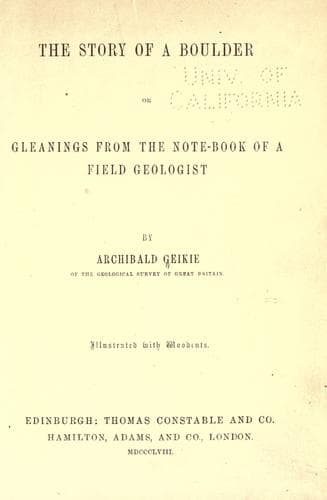
The Story of a Boulder; or, Gleanings from the Note-book of a Field GeologistGeikie, Archibald
Science
The Story of a Boulder; or, Gleanings from the Note-book of a Field Geologist
Geikie, Archibald
Geology; Petrology
designation for all the animals below the vertebrate type.
The most highly developed of the recent cephalopods exhibit a true
internal skeleton, in the form of a strong oblong bone, on which the
body is hung. In this respect they occupy a sort of intermediate place
between the lower molluscs on the one hand, and the lower fishes on
the other. Theirs is not a vertebral column, but rather, as it were,
a foreshadowing of it; not, however, as a link in some process of
self-development from mollusc to fish, for these higher cephalopods do
not appear to have been created until fishes and reptiles had lived
for ages. The vertebrate type has been traced well-nigh as far back
into the past as we have yet been able to penetrate. Once introduced,
it has never ceased to exist, but in the successive geological ages
has been ever receiving newer and higher modifications, reaching its
perfection at length in man. The vertebrate form of structure fulfils
the highest adaptations of which terrestrial beings seem capable. We
can hardly conceive of corporeal existence reaching a more elevated
stage of development, save in thereby becoming less material, and
receiving an impartation of some higher element. The vertebrate
animals display not merely the most complexly organized structures,
but manifest in their habits the workings of the higher instincts
and affections. Among the invertebrate tribes the propagation of the
species is, in the vast majority of cases, a mere mechanical function,
like that of feeding or respiration, and the eggs once deposited, the
parent has no further care of her young. But among the vertebrated
animals, on the other hand, the perpetuation of the race forms the
central pillar round which the natural affections are entwined. It
parcels out every species into pairs, in each of which the mates are
bound together by the strongest ties of attachment. It gives birth,
too, to that noble instinct which leads the mother to expose her own
life rather than suffer harm to come to her offspring. It produces, at
least in man, that reciprocal attachment of offspring to parent, from
which springs no small part of all that is holiest and best in this
world. These attributes, to a greater or less extent, belong to all
the vertebrate animals, from the fish up to man. In looking over the
relics of animal life in the earlier geological formations, we are apt,
as we gaze on the massive jaws and teeth, the strong bony armour, and
the sharp, barbed spines, to think only of a time of war and carnage,
when the larger forms preyed upon the smaller, or ruthlessly sought
to exterminate each other. Yet should we not remember, that with all
these weapons and instincts of self-preservation there were linked
attributes of a nobler kind; that the earliest vertebrate remains point
to the introduction--though perhaps in but a rudimentary form--of
self-sacrificing love into our planet? The march of creation from
Public-domain text, read in full here on John Shaqi.
Reviews
Reviews
No reviews yet
Be the first to share your thoughts on this work.
Elsewhere in the archive
Join the Discussion
Join the discussion
Sign in to leave a comment or review.
Sign InorCreate an account