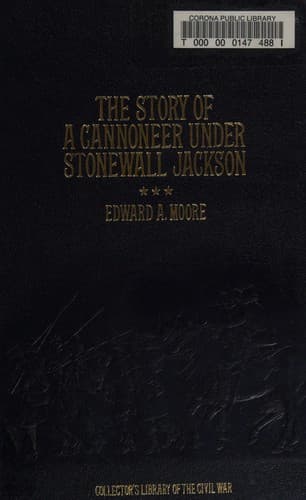
The Story of a Cannoneer Under Stonewall Jackson: In Which is Told the Part Taken by the Rockbridge Artillery in the Army of Northern VirginiaMoore, Edward Alexander
History
The Story of a Cannoneer Under Stonewall Jackson: In Which is Told the Part Taken by the Rockbridge Artillery in the Army of Northern Virginia
Moore, Edward Alexander
Confederate States of America. Army. Virginia Artillery. Rockbridge Battery, 1st; Jackson, Stonewall, 1824-1863; Moore, Edward Alexander, 1842-; Soldiers -- Virginia -- Biography; United States -- History -- Civil War, 1861-1865 -- Campaigns; United States -- History -- Civil War, 1861-1865 -- Perso
We arrived at Camp Buchanan, a few miles below Mount Jackson, on Monday
afternoon. I then, for the first time since April, 1861, saw my brother
John. How tough and brown he looked! He had been transferred to the
Rockbridge Artillery shortly before the first battle of Manassas, and
with my brother David belonged to a mess of as interesting young men as
I ever knew. Some of them I have not seen for more than forty years.
Mentioning their names may serve to recall incidents connected with
them: My two brothers, both graduates of Washington College; Berkeley
Minor, a student at the University of Virginia, a perfect bookworm;
Alex. Boteler, student of the University of Virginia, son of Hon. Alex.
Boteler, of West Virginia, and his two cousins, Henry and Charles
Boteler, of Shepherdstown, West Virginia; Thompson and Magruder Maury,
both clergymen after the war; Joe Shaner, of Lexington, Virginia, as
kind a friend as I ever had, and who carried my blanket for me on his
off-horse at least one thousand miles; John M. Gregory, of Charles City
County, an A. M. of the University of Virginia. How distinctly I recall
his large, well-developed head, fair skin and clear blue eyes; and his
voice is as familiar to me as if I had heard it yesterday. Then the
brothers, Walter and Joe Packard, of the neighborhood of Alexandria,
Virginia, sons of the Rev. Dr. Packard, of the Theological Seminary, and
both graduates of colleges; Frank Preston, of Lexington, graduate of
Washington College, who died soon after the war while professor of Greek
at William and Mary College, a whole-souled and most companionable
fellow; William Bolling, of Fauquier County, student of University of
Virginia; Frank Singleton, of Kentucky, student of University of
Virginia, whom William Williamson, another member of the mess and a
graduate of Washington College, pronounced "always a gentleman."
Williamson was quite deaf, and Singleton always, in the gentlest and
most patient way, would repeat for his benefit anything he failed to
hear. Last, and most interesting of all, was George Bedinger, of
Shepherdstown, a student of the University of Virginia.
There were men in the company from almost every State in the South, and
several from Northern States. Among the latter were two sons of
Commodore Porter, of the United States Navy, one of whom went by the
name of "Porter-he," from his having gone with Sergeant Paxton to visit
some young ladies, and, on their return, being asked how they had
enjoyed their visit, the sergeant said, "Oh, splendidly! and Porter, he
were very much elated."
Soon after my arrival supper was ready, and I joined the mess in my
first meal in camp, and was astonished to see how they relished fat
bacon, "flap-jacks" and strong black coffee in big tin cups. The company
was abundantly supplied with first-rate tents, many of them captured
from the enemy, and everybody seemed to be perfectly at home and happy.
Public-domain text, read in full here on John Shaqi.
Reviews
Reviews
No reviews yet
Be the first to share your thoughts on this work.
Join the Discussion
Join the discussion
Sign in to leave a comment or review.
Sign InorCreate an account