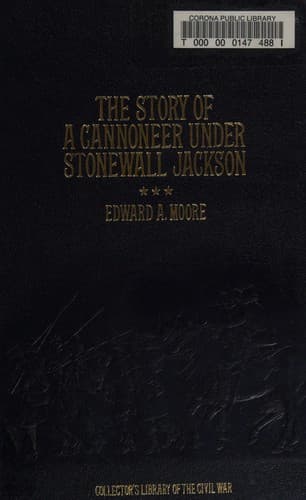
The Story of a Cannoneer Under Stonewall Jackson: In Which is Told the Part Taken by the Rockbridge Artillery in the Army of Northern Virginia — John Shaqi
The Story of a Cannoneer Under Stonewall Jackson: In Which is Told the Part Taken by the Rockbridge Artillery in the Army of Northern VirginiaMoore, Edward Alexander
History
The Story of a Cannoneer Under Stonewall Jackson: In Which is Told the Part Taken by the Rockbridge Artillery in the Army of Northern Virginia
Moore, Edward Alexander
Confederate States of America. Army. Virginia Artillery. Rockbridge Battery, 1st; Jackson, Stonewall, 1824-1863; Moore, Edward Alexander, 1842-; Soldiers -- Virginia -- Biography; United States -- History -- Civil War, 1861-1865 -- Campaigns; United States -- History -- Civil War, 1861-1865 -- Perso
The next dawn brought a raw, gloomy Sunday. We found the battery a mile
or two from the battlefield, where we lay all day, thinking, of course,
the enemy would follow up their victory; but this they showed no
inclination to do. On Monday we moved a mile or more toward our old
camp--Buchanan. On Tuesday, about noon, we reached Cedar Creek, the
scene of one of General Early's battles more than two years afterward,
1864. The creek ran through a narrow defile, and, the bridge having been
burned, we crossed in single file, on the charred timbers, still
clinging together and resting on the surface of the water. Just here,
for the first time since Kernstown, the Federal cavalry attacked the
rear of our column, and the news and commotion reached my part of the
line when I was half-across the stream. The man immediately in front of
me, being in too much of a hurry to follow the file on the
bridge-planks, jumped frantically into the stream. He was fished out of
the cold waters, shoulder deep, on the bayonets of the infantry on the
timbers.
We found our wagons awaiting us on top of a high hill beyond, and went
into camp about noon, to get up a whole meal, to which we thought we
could do full justice. But, alas! alas! About the time the beans were
done, and each had his share in a tin plate or cup, "bang!" went a
cannon on the opposite hill, and the shell screamed over our heads. My
gun being a rifled piece, was ordered to hitch up and go into position,
and my appetite was gone. Turning to my brother, I said, "John, I don't
want these beans!" My friend Bedinger gave me a home-made biscuit, which
I ate as I followed the gun. We moved out and across the road with two
guns, and took position one hundred yards nearer the enemy. The guns
were unlimbered and loaded just in time to fire at a column of the
enemy's cavalry which had started down the opposite hill at a gallop.
The guns were discharged simultaneously, and the two shells burst in the
head of their column, and by the time the smoke and dust had cleared up
that squadron of cavalry was invisible. This check gave the wagons and
troops time to get in marching order, and after firing a few more rounds
we followed.
As we drove into the road again, I saw several infantrymen lying
horribly torn by shells, and the clothes of one of them on fire. I
afterward heard amusing accounts of the exit of the rest of the company
from this camp. Quartermaster "John D." had his teams at a full trot,
with the steam flying from the still hot camp-kettles as they rocked to
and fro on the tops of the wagons. In a day or two we were again in Camp
Buchanan, and pitched our tents on their old sites and kindled our fires
with the old embers. Here more additions were made to the company, among
them R. E. Lee, Jr., son of the General; Arthur A. Robinson, of
Baltimore, and Edward Hyde, of Alexandria. After a few nights' rest and
one or two square meals everything was as gay as ever.
Public-domain text, read in full here on John Shaqi.
Reviews
Reviews
No reviews yet
Be the first to share your thoughts on this work.
Join the Discussion
Join the discussion
Sign in to leave a comment or review.
Sign InorCreate an account