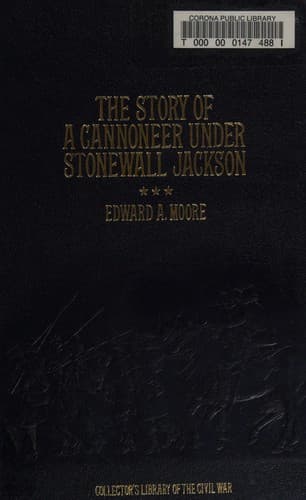
The Story of a Cannoneer Under Stonewall Jackson: In Which is Told the Part Taken by the Rockbridge Artillery in the Army of Northern VirginiaMoore, Edward Alexander
History
The Story of a Cannoneer Under Stonewall Jackson: In Which is Told the Part Taken by the Rockbridge Artillery in the Army of Northern Virginia
Moore, Edward Alexander
Confederate States of America. Army. Virginia Artillery. Rockbridge Battery, 1st; Jackson, Stonewall, 1824-1863; Moore, Edward Alexander, 1842-; Soldiers -- Virginia -- Biography; United States -- History -- Civil War, 1861-1865 -- Campaigns; United States -- History -- Civil War, 1861-1865 -- Perso
By dawn next morning we were again on the march. I have recalled this
early dawn oftener, I am sure, than any other of my whole life. Our road
lay along the edge of a forest, occasionally winding in and out of it.
At the more open places we could see the Blue Ridge in the near
distance. During the night a slight shower had moistened the earth and
leaves, so that our steps, and even the wheels of the artillery, were
scarcely heard. Here and there on the roadside was the home of a
soldier, in which he had just passed probably his last night. I
distinctly recall now the sobs of a wife or mother as she moved about,
preparing a meal for her husband or son, and the thoughts it gave rise
to. Very possibly it helped also to remind us that we had left camp that
morning without any breakfast ourselves. At any rate, I told my friend,
Joe McAlpin, who was quite too modest a man to forage, and face a
strange family in quest of a meal, that if he would put himself in my
charge I would promise him a good breakfast.
In a few miles we reached McGaheysville, a quiet, comfortable little
village away off in the hills. The sun was now up, and now was the time
and this the place. A short distance up a cross-street I saw a
motherly-looking old lady standing at her gate, watching the passing
troops. Said I, "Mac, there's the place." We approached, and I announced
the object of our visit. She said, "Breakfast is just ready. Walk in,
sit down at the table, and make yourselves at home." A breakfast it
was--fresh eggs, white light biscuit and other toothsome articles. A man
of about forty-five years--a boarder--remarked, at the table, "The war
has not cost me the loss of an hour's sleep." The good mother said, with
a quavering tone of voice, "_I_ have sons in the army."
CHAPTER IV
SWIFT RUN GAP--REORGANIZATION OF THE BATTERY--WADING IN THE
MUD--CROSSING AND RECROSSING THE BLUE RIDGE--BATTLE OF McDOWELL--RETURN
TO THE VALLEY
We reached the south branch of the Shenandoah about noon, crossed on a
bridge, and that night camped in Swift Run Gap. Our detail was separated
from the battery and I, therefore, not with my own mess. We occupied a
low, flat piece of ground with a creek alongside and about forty yards
from the tent in which I stayed. The prisoners were in a barn a quarter
of a mile distant. Here we had most wretched weather, real winter again,
rain or snow almost all the time. One night about midnight I was
awakened by hearing a horse splashing through water just outside of the
tent and a voice calling to the inmates to get out of the flood. The
horse was backed half into the tent-door, and, one by one, my companions
left me. My bunk was on a little rise. I put my hand out--into the
water. I determined, however, to stay as long as I could, and was soon
asleep, which showed that I was becoming a soldier--in one important
respect at least. By daylight, the flood having subsided, I was able to
reach a fence and "coon it" to a hill above.
Public-domain text, read in full here on John Shaqi.
Reviews
Reviews
No reviews yet
Be the first to share your thoughts on this work.
Join the Discussion
Join the discussion
Sign in to leave a comment or review.
Sign InorCreate an account