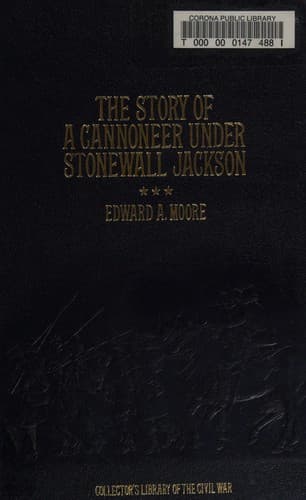
The Story of a Cannoneer Under Stonewall Jackson: In Which is Told the Part Taken by the Rockbridge Artillery in the Army of Northern VirginiaMoore, Edward Alexander
History
The Story of a Cannoneer Under Stonewall Jackson: In Which is Told the Part Taken by the Rockbridge Artillery in the Army of Northern Virginia
Moore, Edward Alexander
Confederate States of America. Army. Virginia Artillery. Rockbridge Battery, 1st; Jackson, Stonewall, 1824-1863; Moore, Edward Alexander, 1842-; Soldiers -- Virginia -- Biography; United States -- History -- Civil War, 1861-1865 -- Campaigns; United States -- History -- Civil War, 1861-1865 -- Perso
The next day we camped near Staunton and remained a day. Conjecturing
now as to Jackson's program was wild, so we concluded to let him have
his own way. The cadets of the Virginia Military Institute, most of whom
were boys under seventeen, had, in this emergency, been ordered to the
field, and joined the line of march as we passed through Staunton, and
the young ladies of that place made them the heroes of the army, to the
disgust of the "Veterans" of the old Stonewall Brigade. Our course was
now westward, and Milroy, who was too strong for General Ed. Johnson in
the Alleghanies, was the object. About twenty miles west of Staunton was
the home of a young lady friend, and, on learning that our road lay
within four miles of it, I determined at least to try to see her.
Sergeant Clem. Fishburne, who was related to the family, expected to go
with me, but at the last moment gave it up, so I went alone. To my very
great disappointment she was not at home, but her sisters entertained me
nicely with music, etc., and filled my haversack before I left. Just
before starting off in the afternoon I learned that cannonading had been
heard toward the front. When a mile or two on my way a passing
cavalryman, a stranger to me, kindly offered to carry my overcoat, which
he did, and left it with the battery.
The battery had marched about fifteen miles after I had left it, so I
had to retrace my four miles, then travel the fifteen, crossing two
mountains. I must have walked at least five miles an hour, as I reached
the company before sundown. They had gone into camp. My brother John,
and Frank Preston, seeing me approach, came out to meet me, and told me
how excessively uneasy they had been about me all day. A battle had been
fought and they had expected to be called on every moment, and, "Suppose
we _had_ gone in, and you off foraging!" How penitent I felt, and at the
same time how grateful for having two such anxious guardians! While
expressing this deep interest they each kept an eye on my full
haversack. "Well," said I, "I have some pabulum here; let's go to the
mess and give them a snack." They said, "That little bit wouldn't be a
drop in the bucket with all that mess; let's just go down yonder to the
branch and have one real good old-fashioned repast." So off we went to
the branch, and by the time they were through congratulating me on
getting back before the battery had "gotten into it," my haversack was
empty. The battle had been fought by Johnson's division, the enemy
whipped and put to flight. The next day we started in pursuit, passing
through McDowell, a village in Highland County, and near this village
the fight had occurred. The ground was too rough and broken for the
effective use of artillery, so the work was done by the infantry on both
sides. This was the first opportunity that many of us had had of seeing
a battlefield the day after the battle. The ghastly faces of the dead
made a sickening and lasting impression; but I hoped I did not look as
Public-domain text, read in full here on John Shaqi.
Reviews
Reviews
No reviews yet
Be the first to share your thoughts on this work.
Join the Discussion
Join the discussion
Sign in to leave a comment or review.
Sign InorCreate an account