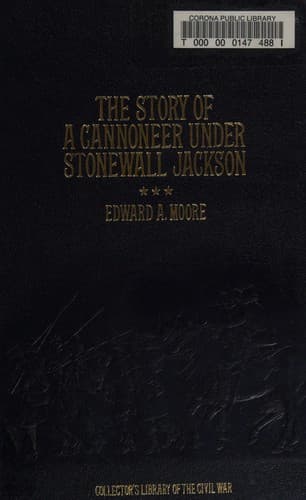
The Story of a Cannoneer Under Stonewall Jackson: In Which is Told the Part Taken by the Rockbridge Artillery in the Army of Northern VirginiaMoore, Edward Alexander
History
The Story of a Cannoneer Under Stonewall Jackson: In Which is Told the Part Taken by the Rockbridge Artillery in the Army of Northern Virginia
Moore, Edward Alexander
Confederate States of America. Army. Virginia Artillery. Rockbridge Battery, 1st; Jackson, Stonewall, 1824-1863; Moore, Edward Alexander, 1842-; Soldiers -- Virginia -- Biography; United States -- History -- Civil War, 1861-1865 -- Campaigns; United States -- History -- Civil War, 1861-1865 -- Perso
Jackson's rapid movements seemed to have taken the enemy entirely by
surprise, and we struck their divided forces piecemeal, and even after
the Front Royal affair their troops at Strasburg, consisting chiefly of
cavalry, had not moved. Two of our guns were sent on with the Louisiana
Tigers, to intercept them at Middletown. The guns were posted about one
hundred and fifty yards from the road, and the Tigers strung along
behind a stone fence on the roadside. Everything was in readiness when
the enemy came in sight. They wavered for a time, some trying to pass
around, but, being pushed from behind, there was no alternative. Most of
them tried to run the gauntlet; few, however, got through. As the rest
of us came up we met a number of prisoners on horseback. They had been
riding at a run for nine miles on the pike in a cloud of white dust.
Many of them were hatless, some had saber-cuts on their heads and
streams of blood were coursing down through the dust on their faces.
Among them was a woman wearing a short red skirt and mounted on a tall
horse.
Confined in a churchyard in the village were two or three hundred
prisoners. As we were passing by them an old negro cook, belonging to
the Alleghany Rough Battery of our brigade, ran over to the fence and
gave them a hearty greeting, said he was delighted to see them "thar,"
and that we would catch all the rest of them before they got back home.
Banks's main force was at Winchester, and thither we directed our
course.
Newtown was the next village, and there we had another skirmish, our
artillery being at one end of the town and the enemy's at the opposite.
In this encounter two members of our battery were wounded. There was
great rejoicing among the people to see us back again and to be once
more free from Northern soldiers. As the troops were passing through
Newtown a very portly old lady came running out on her porch, and,
spreading her arms wide, called out, "All of you run here and kiss me!"
Night soon set in, and a long, weary night it was; the most trying I
ever passed, in war or out of it. From dark till daylight we did not
advance more than four miles. Step by step we moved along, halting for
five minutes; then on a few steps and halt again. About ten o'clock we
passed by a house rather below the roadside, on the porch of which lay
several dead Yankees, a light shining on their ghastly faces.
Occasionally we were startled by the sharp report of a rifle, followed
in quick succession by others; then all as quiet as the grave.
Sometimes, when a longer halt was made, we would endeavor to steal a few
moments' sleep, for want of which it was hard to stand up. By the time a
blanket was unrolled, the column was astir again, and so it continued
throughout the long, dreary hours of the night.
Reviews
Reviews
No reviews yet
Be the first to share your thoughts on this work.
Join the Discussion
Join the discussion
Sign in to leave a comment or review.
Sign InorCreate an account