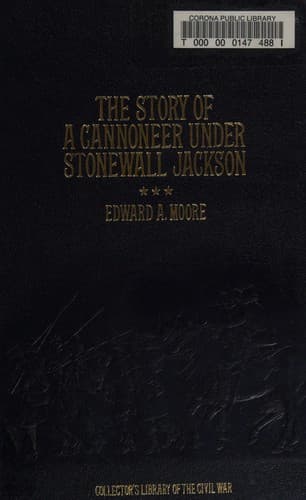
The Story of a Cannoneer Under Stonewall Jackson: In Which is Told the Part Taken by the Rockbridge Artillery in the Army of Northern VirginiaMoore, Edward Alexander
History
The Story of a Cannoneer Under Stonewall Jackson: In Which is Told the Part Taken by the Rockbridge Artillery in the Army of Northern Virginia
Moore, Edward Alexander
Confederate States of America. Army. Virginia Artillery. Rockbridge Battery, 1st; Jackson, Stonewall, 1824-1863; Moore, Edward Alexander, 1842-; Soldiers -- Virginia -- Biography; United States -- History -- Civil War, 1861-1865 -- Campaigns; United States -- History -- Civil War, 1861-1865 -- Perso
For nearly a year (from March to November, 1862) I served in the battery
with this cannoneer, and for a time we were in the same mess. Since the
war I have known him intimately, and it gives me great pleasure to be
able to say that there is no one who could give a more honest and
truthful account of the events of our struggle from the standpoint of a
private soldier. He had exceptional opportunities for observing men and
events, and has taken full advantage of them.
ROBERT E. LEE.
INTRODUCTION BY HENRY ST. GEORGE TUCKER
Between 1740 and 1750 nine brothers by the name of Moore emigrated from
the north of Ireland to America. Several of them settled in South
Carolina, and of these quite a number participated in the Revolutionary
War, several being killed in battle. One of the nine brothers, David by
name, came to Virginia and settled in the "Borden Grant," now the
northern part of Rockbridge County. There, in 1752, his son, afterward
known as Gen. Andrew Moore, was born. His mother was a Miss Evans, of
Welsh ancestry. Andrew Moore was educated at an academy afterward known
as Liberty Hall. In early life with some of his companions he made a
voyage to the West Indies; was shipwrecked, but rescued, after many
hardships, by a passing vessel and returned to the Colonies. Upon his
return home he studied law in the office of Chancellor Wythe, at
Williamsburg, and was licensed to practice law in 1774. In 1776 he
entered the army as lieutenant, in Morgan's Riflemen, and was engaged in
those battles which resulted in the capture of Burgoyne's army, and at
the surrender of the British forces at Saratoga. For courage and
gallantry in battle he was promoted to a captaincy. Having served three
years with Morgan, he returned home and took his seat as a member of the
Virginia legislature, taking such an active and distinguished part in
the deliberations of that body that he was elected to Congress, and as a
member of the first House of Representatives was distinguished for his
services to such a degree that he was re-elected at each succeeding
election until 1797, when he declined further service in that body, but
accepted a seat in the Virginia House of Delegates. He was again elected
to Congress in 1804, but in the first year of his service he was elected
to the United States Senate, in which body he served with distinguished
ability until 1809, when he retired. He was then appointed United States
Marshal for the District of Virginia, which office he held until his
death, April 14, 1821. His brother William served as a soldier in the
Indian wars, and the Revolutionary War. He was a lieutenant of riflemen
at Pt. Pleasant, and carried his captain, who had been severely wounded,
from the field of battle, after killing the Indian who was about to
scalp him--a feat of courage and strength rarely equaled. Gen. Andrew
Moore's wife was Miss Sarah Reid, a descendant of Capt. John McDowell,
who was killed by the Indians, December 18, 1842, on James River, in
Public-domain text, read in full here on John Shaqi.
Reviews
Reviews
No reviews yet
Be the first to share your thoughts on this work.
Join the Discussion
Join the discussion
Sign in to leave a comment or review.
Sign InorCreate an account