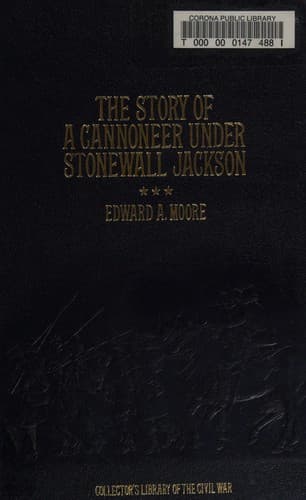
The Story of a Cannoneer Under Stonewall Jackson: In Which is Told the Part Taken by the Rockbridge Artillery in the Army of Northern Virginia — John Shaqi
The Story of a Cannoneer Under Stonewall Jackson: In Which is Told the Part Taken by the Rockbridge Artillery in the Army of Northern VirginiaMoore, Edward Alexander
History
The Story of a Cannoneer Under Stonewall Jackson: In Which is Told the Part Taken by the Rockbridge Artillery in the Army of Northern Virginia
Moore, Edward Alexander
Confederate States of America. Army. Virginia Artillery. Rockbridge Battery, 1st; Jackson, Stonewall, 1824-1863; Moore, Edward Alexander, 1842-; Soldiers -- Virginia -- Biography; United States -- History -- Civil War, 1861-1865 -- Campaigns; United States -- History -- Civil War, 1861-1865 -- Perso
The next man struck was Major Snowdon Andrews, afterward colonel of
artillery. While standing near by us a shell burst as it passed him,
tearing his clothes and wounding him severely. Though drawn to a
stooping posture, he lived many years. Next I saw a ricocheting shell
strike Captain Caskie, of Richmond, Virginia, on his seat, which knocked
him eight or ten feet and his red cap some feet farther. He did not get
straightened up until he had overtaken his cap on the opposite side of
some bushes, through which they had both been propelled. Lieutenant
Graham, of our battery, also received a painful, though not serious,
wound before the day was over. This proved to be a very dangerous place
for officers, but not a private soldier was touched.
By frequent firing during the campaign the vent of my gun had been
burned to several times its proper size, so that at each discharge an
excess of smoke gushed from it. After the captain's attention was called
to it, it happened that a tree in front, but somewhat out of line, was
cut off by a Federal shell just as our gun fired. Supposing the defect
had caused a wild shot, we were ordered to take the gun to the rear, the
other gun soon following. We got away at a fortunate time, as the Second
Brigade of Jackson's division was flanked by the enemy and driven over
the place a few minutes later. One company in the Twenty-first Virginia
Regiment lost, in a few minutes, seventeen men killed, besides those
wounded. The flankers, however, were soon attacked by fresh troops, who
drove them back and took a large number of prisoners, who walked and
looked, as they passed, as if they had done their best and had nothing
of which to be ashamed. By nightfall the whole of Pope's army had been
driven back, and we held the entire battlefield. This battle was called
Cedar Run by the Confederates, and Slaughter's Mountain by the Federals.
On the following day we retraced our steps and occupied an excellent
camping-ground near Gordonsville. Shortly after our arrival, my brother
David, who had been absent on sick-leave, returned from home, bringing a
large mess-chest of delicious edibles, which we enjoyed immensely,
having Willie Preston, from Lexington, who had just joined the College
company, to dine with us. From a nearby cornfield we managed to supply
ourselves with roasting ears, and the number a young Confederate could
consume in a day would have been ample rations for a horse.
Public-domain text, read in full here on John Shaqi.
Reviews
Reviews
No reviews yet
Be the first to share your thoughts on this work.
Join the Discussion
Join the discussion
Sign in to leave a comment or review.
Sign InorCreate an account