Produced by Dagny; John Bickers
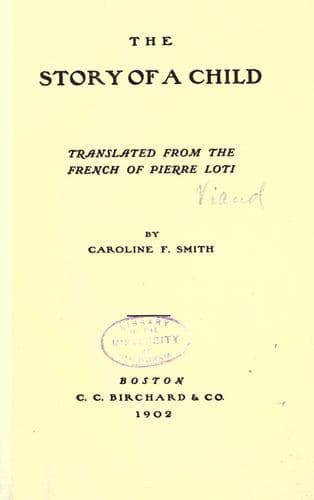
THE STORY OF A CHILD
By Pierre Loti
Translated by Caroline F. Smith
PREFACE
There is to-day a widely spread new interest in child life, a desire to
get nearer to children and understand them. To be sure child study is
not new; every wise parent and every sympathetic teacher has ever been
a student of children; but there is now an effort to do more consciously
and systematically what has always been done in some way.
In the few years since this modern movement began much has been
accomplished, yet there is among many thoughtful people a strong
reaction from the hopes awakened by the enthusiastic heralding of the
newer aspects of psychology. It had been supposed that our science would
soon revolutionize education; indeed, taking the wish for the fact, we
began to talk about the new and the old education (both mythical) and
boast of our millennium. I would not underrate the real progress, the
expansion of educational activities, the enormous gains made in many
ways; but the millennium! The same old errors meet us in new forms, the
old problems are yet unsolved, the waste is so vast that we sometimes
feel thankful that we cannot do as much as we would, and that Nature
protects children from our worst mistakes.
What is the source of this disappointment? Is it not that education,
like all other aspects of life, can never be reduced to mere science? We
need science, it must be increasingly the basis of all life; but exact
science develops very slowly, and meantime we must live. Doubtless the
time will come when our study of mind will have advanced so far that we
can lay down certain great principles as tested laws, and thus clarify
many questions. Even then the solution of the problem will not be in the
enunciation of the theoretic principle, but will lie in its application
to practice; and that application must always depend upon instinct,
tact, appreciation, as well as upon the scientific law. Even the aid
that science can contribute is given slowly; meanwhile we must work with
these children and lift them to the largest life.
It is in relation to this practical work of education that our effort to
study children gets its human value. There are always two points of
view possible with reference to life. From the standpoint of nature
and science, individuals count for little. Nature can waste a thousand
acorns to raise one oak, hundreds of children may be sacrificed that
a truth may be seen. But from the ethical and human point of view the
meaning of all life is in each individual. That one child should be lost
is a kind of ruin to the universe.
It is this second point of view which every parent and every teacher
must take; and the great practical value of our new study of children
is that it brings us into personal relation with the child world, and so
aids in that subtle touch of life upon life which is the very heart of
education.
Public-domain text, read in full here on John Shaqi.
Reviews
Reviews
No reviews yet
Be the first to share your thoughts on this work.
Join the Discussion
Join the discussion
Sign in to leave a comment or review.
Sign InorCreate an account