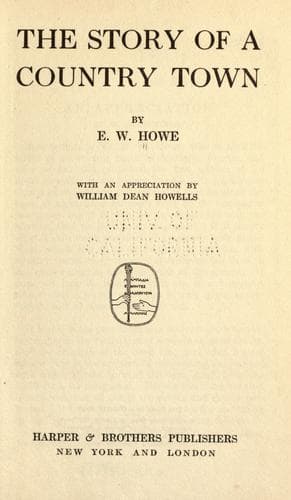
The Story of a Country TownHowe, E. W. (Edgar Watson)
General
The Story of a Country Town
Howe, E. W. (Edgar Watson)
Frontier and pioneer life -- Kansas -- Fiction
There was also a large advertisement of the paper itself, occupying two
full columns, commencing with the figures of the year in which it was
established, and the figures of the current year (from which I made out
that the paper had been published seven years), followed by “Subscribe,”
“Subscribe,” in large black letters. Then came a long platform of dull
political principles, and a declaration that it was the duty of every
good citizen to take it, because it advocated Benton County first, and
the world afterward. After this came a paragraph, separated from the
other part of the advertisement by dashes and o’s (--o--o--), stating
that job printing in all its branches, from a mammoth poster to the most
delicate visiting card, would be neatly and promptly executed on the new
and fast presses belonging to the establishment, and immediately above
the information that all letters should be addressed to the proprietor
to insure prompt attention (as though there had once been a habit of
sending letters intended for the printer to the blacksmith), it was said
that one copy one year would be two dollars, invariably in advance; one
copy six months, one dollar, also invariably in advance; one copy three
months, fifty cents, also invariably in advance; and that single copies
in neat wrappers for mailing could be had on application at five cents
each.
We had no idea what the business was like, and sat there until midnight
discussing and wondering about it, occasionally referring to the sheet
to prove or disprove a notion advanced by one of the number. My own idea
was that the paper was bought in a distant market, as an article of
merchandise, and that my part of the business would be to stand behind a
counter and sell copies at an advance in connection with mammoth posters
and delicate visiting cards, but Agnes said that while she knew nothing
about the newspaper business, she was certain that idea was wrong, and
so it turned out.
When I suggested that Agnes could no longer live with us--it occurred to
me all of a sudden, very late in the evening, and almost took my breath
away--my mother (who had evidently not thought of it before, either) got
up hurriedly, and went out of the room. I expressed the fear that she
had gone away to cry about it, whereupon Agnes went after her, and came
leading her back presently, with her arms tenderly about her.
“I can come over every Saturday,” Agnes said, “and we shall all be so
busy during the week as not to notice the separation. I shall miss you
more than you can possibly miss me, for I always think of this as my
home, but it is not far, and we shall often be together. My school will
be out in three weeks, when I will come over and stay until you are
tired of me.”
Public-domain text, read in full here on John Shaqi.
Reviews
Reviews
No reviews yet
Be the first to share your thoughts on this work.
Elsewhere in the archive
Join the Discussion
Join the discussion
Sign in to leave a comment or review.
Sign InorCreate an account