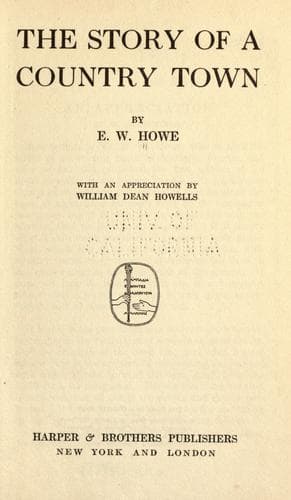
The Story of a Country TownHowe, E. W. (Edgar Watson)
General
The Story of a Country Town
Howe, E. W. (Edgar Watson)
Frontier and pioneer life -- Kansas -- Fiction
As though we should ever tire of Agnes! But my mother would not be
comforted, and continued to cry softly to herself--thinking, I have no
doubt, that she was about to separate from the only creature in all the
world who had ever been kind, and considerate, and fond of her. When I
went to bed, I left them together, Agnes gently stroking my mother’s
hair, and assuring her that she was her dear, kind, good friend, and
that she would never forget how welcome she had always been made in her
new home.
CHAPTER XV.
THE COUNTRY TOWN.
It was barely daylight the following Monday morning, when I started with
my father for Twin Mounds, where we were to take possession of the
“Union of States” newspaper. As we were getting into the wagon, Agnes
came out to hand me a letter, which she said she had written the night
before because opportunity did not present itself to tell me what it
contained. As my father was impatiently waiting to start, with the lines
in his hands, I only had time to say that I would see her in a few
weeks, and, kissing my hand to her, we drove away. She waved her
handkerchief until we were out of sight, when I soon forgot her and the
letter in the excitement of the visit to a strange place and the
engaging in a work of which I had no knowledge.
My father’s usual humor had returned, and he drove along without
speaking, except occasionally to the horses. Once or twice he began to
sing the songs for which he was famous, but he was evidently not in tune
that day, for he soon gave it up.
I had never been to Twin Mounds, as there was a post-office and a small
trading-place several miles nearer, and had no idea how it looked, and
knew nothing of it, except that it had a brick court-house, a stone
jail, several wooden stores, a school-house, and about six hundred very
wicked people. This I had incidentally learned from listening to people
talk who had been there, and I was so occupied in thinking it all over
that I had no inclination to talk, and it occurred to me that after I
grew up, perhaps I shall be a thinking man, like my father, for we did
not exchange a word during the long drive. Several times as we drove
along I caught him looking at me, and I thought he was wondering how I
would get on in the new business, but as he looked away quickly when I
caught him at it, I concluded he was at his old habit of mentally
accusing me of being dull, which made me very wretched. I never knew
what his objection to me was, but I always believed that when he looked
at me, and then resumed his thinking, he was accusing me of something.
Public-domain text, read in full here on John Shaqi.
Reviews
Reviews
No reviews yet
Be the first to share your thoughts on this work.
Elsewhere in the archive
Join the Discussion
Join the discussion
Sign in to leave a comment or review.
Sign InorCreate an account