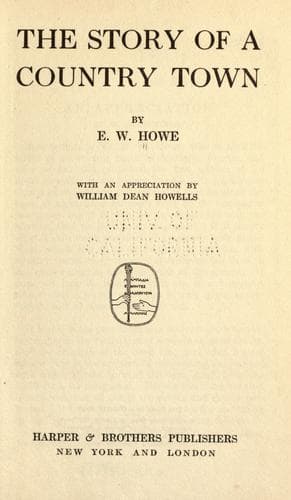
The Story of a Country TownHowe, E. W. (Edgar Watson)
General
The Story of a Country Town
Howe, E. W. (Edgar Watson)
Frontier and pioneer life -- Kansas -- Fiction
When my father was away, I was expected to stay at home, and I could not
help noticing that my mother was growing paler and weaker, and that the
old trouble of which she had spoken to Jo was no better. The house in
which we lived was built of square blocks of stone, and the walls were
so thick, and the windows so small, that I used to think of her as a
prisoner shut up in it. The upper part was not used, except when I went
there to sleep, and it was such a dismal and lonely place that I was
often awakened in the night with bad dreams, but I always had company,
for I found her sleeping on a pallet by the side of my bed, as though
she was glad to be near me. I never heard her come, or go away, but if I
awoke in the night I was sure to find her by my side.
“There is a great change in you, Ned,” she said to me one evening when I
had gone to stay with her, “since coming to town.”
I replied that I was glad to hear her say so, as I was very ignorant
when I went into the office to work.
“The rest of us are unchanged,” she said. “We are no happier here than
in Fairview; just the same, I think.”
It was the only reference she had ever made to the subject to me, and I
did not press it, for I feared she would break down and confess the
sorrow which filled her life. A great many times afterwards I could have
led her up to talk about it, fully and freely, I think, but I dreaded to
hear from her own lips how unhappy she really was. Had I those days to
live over--how often are those words said and written, as though there
is a consciousness with every man of having been unwise as well as
unhappy in his youth--I would pursue a different course, but it never
occurred to me then that I could be of more use to her than I was, or
that I could in any way lessen her sorrow. She never regretted that I no
longer slept in the house, nor that I was growing as cold toward her as
my father, which must have been the case, so I never knew that she cared
much about it. Indeed, I interpreted her unhappiness as indifference
toward me, and it had been that way since I could remember. Had she put
her arms around me, and asked me to love her because no one else did, I
am sure I should have been devoted to her, but her quietness convinced
me that she was so troubled in other ways that there was no time to
think of me, and while I believe I was always kind and thoughtful of
her, I fear I was never affectionate.
CHAPTER XVII.
THE FELLOW.
Although I met him almost every day, I never cared to renew my
acquaintance with Clinton Bragg. The dislike was evidently mutual, for
while he never came in my way, I knew he made fun of me, as he did of
every one else, and I believe he had an ill word for whatever I did or
attempted.
Public-domain text, read in full here on John Shaqi.
Reviews
Reviews
No reviews yet
Be the first to share your thoughts on this work.
Elsewhere in the archive
Join the Discussion
Join the discussion
Sign in to leave a comment or review.
Sign InorCreate an account