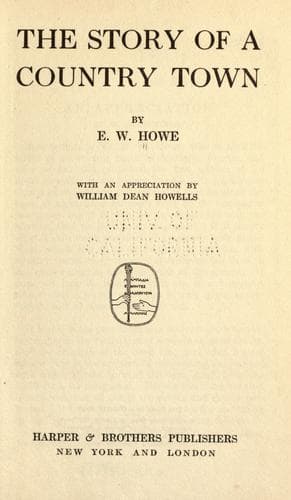
The Story of a Country TownHowe, E. W. (Edgar Watson)
General
The Story of a Country Town
Howe, E. W. (Edgar Watson)
Frontier and pioneer life -- Kansas -- Fiction
Although it was said that he drank more than was good for him, he did
not have the appearance of a drunkard, and it seemed to me that when he
was drinking, he was anxious that everybody know it, and that he drank
more because it was contemptible and depraved than because he had an
appetite. A few of the sentimental people said that were it not for his
dissipating, he could greatly distinguish himself, and that he was very
talented; therefore I think he drank as an apology for his
worthlessness, knowing he could never accomplish what the people said he
could if he remained sober. He probably argued that if he kept his
breath smelling with liquor, he would only have to answer to the public
for that one fault (receiving at the same time a large amount of
sympathy, which a better man would have rejected), whereas if he kept
sober he would be compelled to answer to the charge of being an insolent
loafer, and a worthless vagabond.
From a long experience with it, I have come to believe that the question
of intemperance has never been treated with the intelligence which has
distinguished this country in most other particulars. We pet drunkards
too much, and a halo of sentimentality surrounds them, instead of the
disgust and contempt they deserve. If a man is a noted liar, or a noted
vagrant, society allows him to find his proper level, and reform himself
(since no one else can do it for him), but if he drinks too much, great
numbers of men and women who are perhaps temperate in nothing except
that they do not drink, attempt to reform him with kindness, although
that method prevails in nothing else. As a reason why he should not
dissipate, he is told what distinguished positions he could occupy but
for the habit, and while this is well-intended, the facts generally are
that the fellow is entirely worthless whether drunk or sober. The young
man who practises temperance in the whiskey and other particulars
because it is necessary in his ambition to be of use to himself and to
those around him, is entirely neglected that the disgusting pigs who
swill that which is ruinous to health, mind, and pocket may be
“encouraged,” and who perhaps only drink for the poor kind of attention
it insures them, and from being told of it so often, they come to
believe themselves that but for their dissipation they would be
wonderful fellows, so it often happens that their egotism is even more
detestable than their maudlin drunkenness. Many young men are thus led
into the false notion that great brains feed on stimulants, and regard
an appetite as intellectual.
Public-domain text, read in full here on John Shaqi.
Reviews
Reviews
No reviews yet
Be the first to share your thoughts on this work.
Elsewhere in the archive
Join the Discussion
Join the discussion
Sign in to leave a comment or review.
Sign InorCreate an account