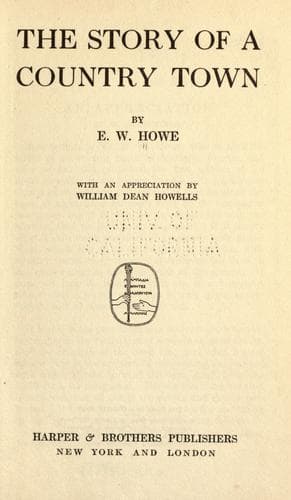
The Story of a Country TownHowe, E. W. (Edgar Watson)
General
The Story of a Country Town
Howe, E. W. (Edgar Watson)
Frontier and pioneer life -- Kansas -- Fiction
The same mistaken people also talk too much about the allurements and
pleasures of drink; of the gilded palaces where drink is sold, and of
its pleasing effects, causing young men and boys who would otherwise
never have thought of it to be seized with an uncontrollable desire to
try the experiment for themselves, although there is nothing more
certain than that all of this is untrue. They visit these places, to
begin with, because they have been warned so frequently against them,
and before they find out--which they are certain to, sooner or
later--that whiskey is man’s enemy in every particular, and his friend
in nothing; that the “gilded palaces” in which it is sold are low dens
kept by men whose company is not desirable; that the reputed pleasure in
the cup is a myth; and that drinking is an evidence of depravity as
plainly marked as idleness and viciousness,--they form the habit, and
become saloon loafers. I firmly believe that hundreds of young men
become drunkards by misrepresentation of this sort, whereas the truth is
easier told, and would prove more effective in keeping them away.
The first step in a career of dissipation is not the first glass, as is
sometimes asserted, but a cultivation of saloon society. There is
nothing to do in a place where drink is sold, no other amusement or
excuse for being there, than to drink, gamble and gossip, and when a man
learns to relish the undesirable company common to such places, the
liquor habit follows as a matter of course, but not before. It is an
effort for most men to drink whiskey, even after they have become
accustomed to its use; it is naturally disgusting to every good quality,
and every good thought; it jars every healthy nerve as it is poured down
the throat; it looks hot and devilish in the bottle, and gurgles like a
demon’s laugh while it is being poured out, and until the young men of
the country are taught that drinking is low and vicious rather than
intellectual, we cannot hope for a reform in this grave matter.
I believe that familiarity with it breeds contempt, for I have noticed
that very few drunkard’s sons follow in the footsteps of their fathers,
and the men who sell it seldom drink it. Most drunkards are such
notorious liars that little can be told from their confessions, but if
accurate statistics could be collected, it would no doubt turn out that
most men having the habit formed it because they were particularly
warned against it. To say to a man that he shall not drink creates
within him a strong desire to drink to excess, and prohibitory laws
generally increase rather than decrease the consumption of liquor,
because of this strange peculiarity. We regulate other evils, and admit
they cannot be blotted out, but with strange inconsistency we insist
that liquor of every kind must be driven from the face of the earth;
that to regulate such a horrible evil is a compromise with the Devil,
and that efforts for its extermination only are worthy of temperate men
and women.
Public-domain text, read in full here on John Shaqi.
Reviews
Reviews
No reviews yet
Be the first to share your thoughts on this work.
Elsewhere in the archive
Join the Discussion
Join the discussion
Sign in to leave a comment or review.
Sign InorCreate an account