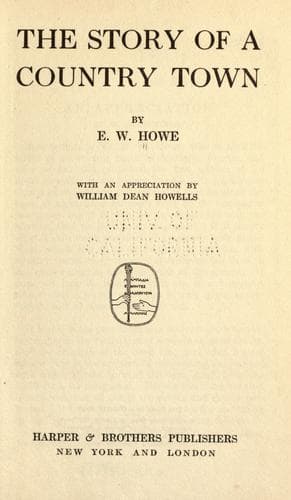
The Story of a Country TownHowe, E. W. (Edgar Watson)
General
The Story of a Country Town
Howe, E. W. (Edgar Watson)
Frontier and pioneer life -- Kansas -- Fiction
“You are going to Jo Erring’s, of course,” he said, after seeing that
the horse led well. “It is a remarkable coincidence--so am I. I suppose
you are not old enough to know it, but it only happens once in a
lifetime that when you are walking a long road--or riding on a horse’s
back, which I think is worse--you overtake an easy-riding buggy going in
the same direction, and containing but one person, although you meet a
great many vehicles going the other way. It is on the same principle
that if you go up stairs to strike a light, and take but one match, it
is certain to go out, but if you take half a dozen, the first one
answers every purpose.”
His good spirits were rapidly returning by reason of release from the
hard-trotting horse’s back, and after finishing this speech he occupied
himself for a while in brushing the dust from his clothing with a small
wisp he took from his pocket.
“I am on my way to see Jo Erring with reference to the mill,” he began
at once. “I have charge of the fund being raised to help him, and I
shall be able to report that the amount is subscribed. I am acting for
Damon Barker, as you may, or may not, happen to know, and although our
friend believes the Fairview farmers are very enthusiastic to help him,
they are really very slow, and I have had some difficulty in convincing
them that it was to their interest. I shall also recommend that he build
the mill as soon as possible. There is no reason why it should drag
through another year, and that is the promise I gave in securing these
papers.”
He significantly tapped a pocket-book, almost as large as himself, in an
outside pocket, and which no doubt contained the obligations to pay
certain sums of money at an agreed date. He always carried this book in
a conspicuous way, and handled it as though it contained great sums of
money, but as he looked through it for something I saw there was nothing
in it except the obligations, a great many newspaper scraps, a few old
letters, one or two postage stamps, and a piece of court plaster.
“I don’t mind confessing to you,” Mr. Biggs continued, with delightful
candor, “that I flattered them into it. In case you do not become
disgusted with the ignorance which renders such a thing possible, you
can flatter men into anything. When I go into a new neighborhood to
organize an Alliance, I get the prompt assistance of every man I meet
by telling him that I can’t hope to do any thing without HIS aid, as HE
has the popular confidence, and the people will follow wherever HE
leads. ‘YOU are a man of intelligence,’ I say. ‘YOU can readily
understand what I have to offer, and will see its benefit at once. But
your neighbors are slower, and I will not attempt an organization here
without your assistance.’ That kind of argument never fails, and as I
talk to all of them in the same way, there is a great deal of
enthusiasm, each one imagining that the others went into it on his
recommendation. I worked up the mill subscription in that way.”
Public-domain text, read in full here on John Shaqi.
Reviews
Reviews
No reviews yet
Be the first to share your thoughts on this work.
Elsewhere in the archive
Join the Discussion
Join the discussion
Sign in to leave a comment or review.
Sign InorCreate an account