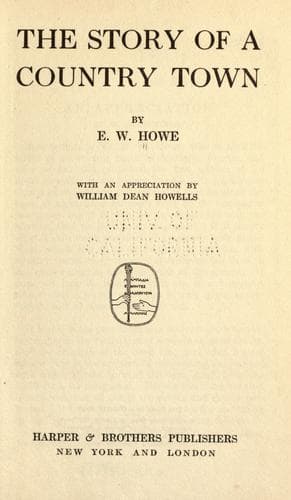
The Story of a Country TownHowe, E. W. (Edgar Watson)
General
The Story of a Country Town
Howe, E. W. (Edgar Watson)
Frontier and pioneer life -- Kansas -- Fiction
I doubt if this statement was true, for the people originated the idea
themselves, but to illustrate a great truth Mr. Biggs did not hesitate
to tell a great lie.
“I make a great deal of money in organizing Alliances, but sometimes I
think of going out of the business because I meet so many silly men that
it disgusts me, and I become ashamed of my sex. But I suppose every
business has that draw back, for every man I have ever talked with was
of the opinion that his business developed more silly men, more
contemptible men, and more mean men than any other calling, and I am
forced to conclude that these qualities are so common that they are met
with everywhere.”
When he spoke of retiring from the business of organizing Alliances, I
was about to say that publishing a newspaper collected about all the
objectionable men within reach, but from what he said afterwards I
judged the observation would not be well received. As if he understood
that I was about to say something, which he did not allow, he
continued:--
“I was about to say, however, when you interrupted me (I had not spoken
at all), that the way to get rich is to go in debt, and work out,
therefore I shall recommend that Jo Erring complete his mill at once. No
matter if he goes in debt; he has health and can pay it. The people of
the country through which we are passing believe it the best to pay as
you go. That party over in the field, for instance, is ploughing his
corn with a single shovel plough, whereas there are dealers in town who
would readily take his note for a cultivator with four shovels and a
riding seat. His library no doubt consists of a book warning him against
counting his chickens before they are hatched--as pointless a suggestion
as I ever heard in my life, by the way (for why do we set eggs if not to
bring forth chickens)--but it is regarded as fine logic here. The man
will die some of these days with his single shovel plough, his slab
house, his cow, his two horses, and his handful of land paid for, worth
altogether from three to seven hundred dollars, but if he has a neighbor
who sets a good many hens with care, AND counts the number of chickens
they can reasonably be expected to hatch, he will attend the funeral in
a carriage, and look at his remains through gold-rimmed spectacles.”
I had regarded this pay-as-you-go principle as a very good one, but he
convinced me that I was mistaken, as usual, for I could never dispute
his philosophy until I had thought over it a day or two, when its
sophistry seemed quite clear. I had remarked of Mr. Biggs before that he
seemed to understand what was in my mind, and attack it. I was thinking
that the man he was talking about--his name was McJohn, and a local
curiosity because his voice was uncertain, and jumped from a high
falsetto to a guttural bass--had the reputation of being the hardest
working man in Fairview, when my companion said:--
Public-domain text, read in full here on John Shaqi.
Reviews
Reviews
No reviews yet
Be the first to share your thoughts on this work.
Elsewhere in the archive
Join the Discussion
Join the discussion
Sign in to leave a comment or review.
Sign InorCreate an account