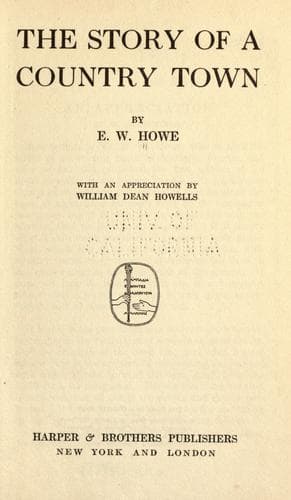
The Story of a Country TownHowe, E. W. (Edgar Watson)
General
The Story of a Country Town
Howe, E. W. (Edgar Watson)
Frontier and pioneer life -- Kansas -- Fiction
“I never knew a man, I believe, who didn’t boast occasionally that he
worked harder than his neighbor; I wonder it never occurs to them that
it is to their discredit, unless they are more prosperous than any of
those around them, for if their neighbors work less, and succeed as well
or better, it is an indication that they have more sense. I have no
doubt that McJohn, as he spends his time in ploughing a field which
could be done in one-fourth the time with common sense and a cultivator,
thinks that no other man’s lot is as hard as his, and that he is a
martyr to hard work. Before I became a philosopher--when I was a fool,
in short--I boasted that no man worked as hard as I did, but now I boast
that no man works so little. But simply because a man says he is the
hardest-working man in the country, it does not follow that it is true.
Every traveller who crosses the ocean says that the captain (who had
been at sea continuously for thirty years) came into the cabin during
the storm, and said it was the worst he had ever experienced. I have no
doubt the captains say so (there is no reason why sea captains should
not lie as well as other men), but only to impress the passengers with
their remarkable skill in managing the vessel under such critical
circumstances. You may have noticed that every winter is the coldest
ever known, and every summer the hottest; the people seem to expect
picnics in December and skating in July, but the facts are that it is
always cold in December and always warm in July.”
I would have made oath, if necessary, that I had heard Mr. Biggs many a
time complaining of the excessively hot and cold days, and declaring
that there was never before anything like it.
“The people here learn nothing by experience,” he proceeded. “Since I
have lived in the West, every spring has been made gloomy by the
lamentations of the farmers that crops were ruined, but just before the
crops were burned up--as the tooth came just before the doctor killed
the boy--the rains come, and the crops do very well. You will find that
the men who carry the fate of the country around on their shoulders do
not get on so well as the country. I have always found it safe to trust
the country to take care of itself, for the country usually does very
well.”
We were riding on the high prairie now, with Fairview church in sight,
and the little man regarded the big building with a show of the contempt
I had seen him exhibit on looking at big men.
Public-domain text, read in full here on John Shaqi.
Reviews
Reviews
No reviews yet
Be the first to share your thoughts on this work.
Elsewhere in the archive
Join the Discussion
Join the discussion
Sign in to leave a comment or review.
Sign InorCreate an account