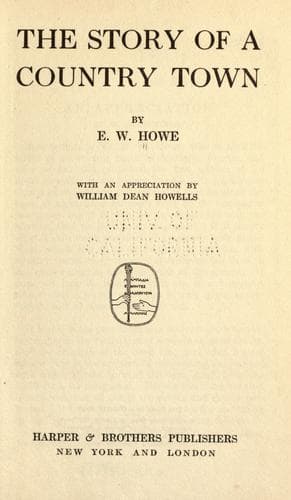
The Story of a Country TownHowe, E. W. (Edgar Watson)
General
The Story of a Country Town
Howe, E. W. (Edgar Watson)
Frontier and pioneer life -- Kansas -- Fiction
“You say that whenever we meet. You forget that we are both older, and
that it has been almost four years since we were constantly together. It
was always our ambition, when we were boys, to become men: we are
becoming men very rapidly, and while I am satisfied, you seem to
complain of it. But we never become so old that we do not have care and
responsibility, and I look like a thoughtful man to you only because in
the course of years I have grown to be a thoughtful man. Further than my
work there is nothing to make me thoughtful but the age I have
accumulated naturally, and I look older because I AM older. Let me
assure you once for all, my good old friend, that I am stout as a lion;
I am prosperous; I am to be married in a few hours to the woman of my
choice, and that there is no reason why I should not live to a ripe old
age in the greatest peace. There! Are you satisfied?”
“I enjoyed your friendship so much when you were a boy,” I answered,
“that perhaps it is only a fear that it will be less candid when we are
men. I have had no other confidant than you, and I dread to see you grow
old, for fear that a man’s cares will cause you to forget our boyish
friendship.”
“No fear of that,” he said, after he had studied awhile, as if turning
it all over in his mind. “No fear of that. I shall never grow too old to
confide my sorrows (if I have them) and successes to you. However poorly
a man is raised, he always has a pleasant recollection of his youth. It
may be only the hut in which he was born, but there is always something,
and you are the one pleasant recollection of my boyhood. If I had a
great trouble, I should come to you with it; not for help, perhaps, but
for your honest sympathy, and for the satisfaction of talking it over
freely. So long as I confess nothing to you, you may rest assured that I
am very happy. I don’t feel right just now, some way, and I can see that
you don’t; but I hope we shall get on better later in the day. I am very
sorry, but for some reason the occasion does not promise to be what I
expected. Probably one reason is that I have done a very mean thing
to-day, and when you discover it, as you are sure to do, remember that I
have confessed my humiliation, and say nothing about it.”
I had no idea what it was, but as he said I should discover it, I did
not press him further.
Public-domain text, read in full here on John Shaqi.
Reviews
Reviews
No reviews yet
Be the first to share your thoughts on this work.
Elsewhere in the archive
Join the Discussion
Join the discussion
Sign in to leave a comment or review.
Sign InorCreate an account