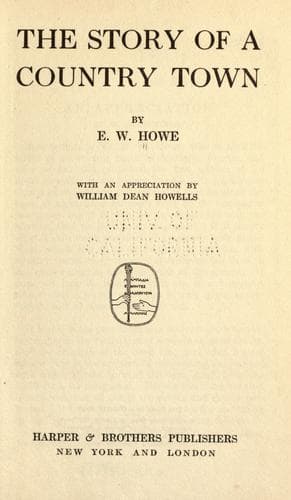
The Story of a Country TownHowe, E. W. (Edgar Watson)
General
The Story of a Country Town
Howe, E. W. (Edgar Watson)
Frontier and pioneer life -- Kansas -- Fiction
“It is very curious,” Jo said, in a confidential and perplexed way, “but
the nearer my marriage approaches, the less important it seems; I wonder
that I am so cool over it. You remember what I said to you once about
it--that I would sell myself to the Devil to be married to Mateel; THEN,
not to wait a minute. I felt what I said, but the years of waiting have
made a great change in me. Not that I am less fond of her, but I do not
feel now about it as I did the night we rode to Barker’s the first year
of my apprenticeship. It was never intended, perhaps, for anyone to be
as happy as I should have been had my marriage to Mateel that night been
possible. Somehow we always have to wait until the pleasure of an event
is blunted by familiarity. Imperceptibly, as she became a possibility, I
made the discovery that she is not an angel--she would be an angel, I
have no doubt, were such a thing possible--for angels do not live in the
woods, and they do not marry millers.”
He tried very hard to be cheerful, but he could not, and when he spoke I
thought it was an apology for his troubled face:--
“I am very tired of late, for I have worked almost night and day for
four years, and I hope you will excuse me if I do not seem glad to see
you, for I am; though just at present, for some unaccountable reason, I
am unable to show it. I am sure I shall perceptibly revive by reason of
your being here, but the mill undertaking was a big one, though I shall
speedily recover, now that I have more ease. I can’t just explain myself
how it is, but I hope you will believe I am still Jo Erring, and still
regard you as my best friend.”
I made some sort of an answer, and we went into the house soon after,
both of us more than ever convinced that something was wrong, though we
could not tell what it was. Jo immediately disappeared into another
room, leaving me alone until Mr. Shepherd came in, who, although he
seemed glad to see me, was in such great excitement that he had not time
to express it.
“You will excuse me if I am not myself,” he said, as he walked about,
putting his hands to his head as though it pained him, a habit I had
noticed before. “While I approve of this marriage, our only child leaves
us to-day, and we cannot feel very gay about it. She has hardly been out
of our sight since she was born, and so far from feeling gay, we are
uncomfortable, although we have no objection to her husband. It
distresses her poor mother more than it does me; I fear it will be like
a funeral. I hope Jo will not mind if she breaks down entirely. I had
been hoping we should be very happy to-day, but I have lost all hope of
it.”
Public-domain text, read in full here on John Shaqi.
Reviews
Reviews
No reviews yet
Be the first to share your thoughts on this work.
Elsewhere in the archive
Join the Discussion
Join the discussion
Sign in to leave a comment or review.
Sign InorCreate an account